
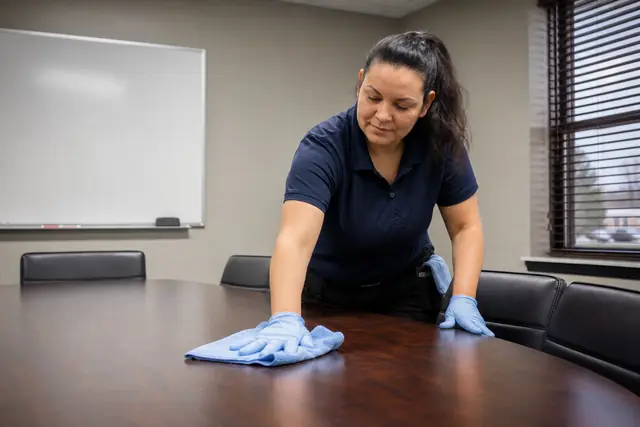
Janitorial Checklist: What a Nightly Office Clean Should Cover
The nightly, weekly and monthly tasks that keep an office clean, healthy and ready for clients, area by area.
A janitorial checklist is the written list of tasks a cleaning crew completes every visit, plus the deeper jobs it rotates weekly and monthly. For an office, the nightly list covers trash, restrooms, break rooms, high-touch surfaces and floors. Weekly and monthly tasks handle dusting, glass, baseboards and carpet. Without a written checklist, those deeper tasks are the first to get skipped.
We clean offices, churches, daycares and medical offices around Warren and Youngstown every week, and the checklist is what makes the difference between a crew that "comes by" and a building that actually stays clean. Below is the checklist we work from, organized by area, with the research behind why each item is there. Want a crew to run it for you? See our office cleaning service.
Why Does an Office Need a Written Janitorial Checklist?
In 2024, the CDC's guidance "When and How to Clean and Disinfect a Facility" told businesses to clean high-touch surfaces regularly, naming door handles, counters, elevator buttons, touchpads, restroom fixtures and desks. A checklist turns "regularly" into specific tasks on specific nights, so nothing depends on memory.
A checklist also protects you when you switch cleaning companies or crew members change. The list stays the same, so the results stay the same. And it gives you something to check against. If the breakroom fridge handle isn't on the list, how would you know it's being missed?
There's a legal floor too. In OSHA standard 1910.141, the federal sanitation rule, "all places of employment shall be kept clean," floors must be kept dry where practicable, and every restroom sink needs running water, hand soap and towels or air dryers. A nightly checklist is the easiest way to show you meet it.
Cleaning vs Disinfecting: What Is the Difference?
The CDC explains that cleaning with soap or detergent "decreases the number of germs," while disinfecting "can kill harmful germs that remain on surfaces after cleaning." The two steps do different jobs, and a good janitorial checklist marks which surfaces get which treatment, in that order.
| Step | What it does | Where it belongs on the checklist |
|---|---|---|
| Clean | Removes dirt, dust, spills and some germs with soap or detergent and water | Every surface: desks, counters, floors, glass, fixtures |
| Disinfect | Uses an EPA-registered product with the right contact time to kill germs left after cleaning | High-touch points, restrooms, break room handles, and anywhere someone has been sick |
Here's the practical takeaway we build into every plan: disinfectant sprayed on a dirty surface doesn't work well, because grime shields the germs. So the checklist always reads "clean, then disinfect," and the crew leaves the disinfectant wet for the time printed on the label before wiping.
Which Office Surfaces Collect the Most Germs?
In a 2019 study in the International Journal of Hygiene and Environmental Health, University of Arizona researchers tracked a harmless tracer virus through an office building. The most contaminated spots were break room refrigerator and drawer handles, sink faucets, the main exit push bar and the women's restroom soap dispensers.
Keyboards and phones are another problem. A 2018 peer-reviewed study in the International Journal of Environmental Research and Public Health found bacteria on 96% of keyboards and 92% of mobile phones tested. After an antimicrobial wipe, bacteria were fully gone from 60.9% of phones but only 16.7% of keyboards, because bacteria hide between the keys.
The good news: the same University of Arizona study found that disinfecting high-touch surfaces, combined with hand sanitizer, cut virus levels by 85.4% on average. That's why high-touch points get their own line on our nightly list instead of being lumped in with "wipe surfaces."
Notice what's on that hot-spot list. It's mostly shared surfaces in the break room, restroom and exits, not individual desks. If your current cleaner spends most of the night on desks and skips the fridge handle and exit bar, the checklist is pointed at the wrong places.
The Nightly Janitorial Checklist, Area by Area
This is the core of the list, the work done every visit. Most offices we clean in Trumbull and Mahoning County are on two to five nights a week, and this is what each of those nights covers.
Entry and Lobby
- Empty trash and replace liners
- Clean glass entry doors and push bars, inside and out
- Disinfect the main exit push bar and door handles
- Vacuum or shake out entry mats
- Sweep and damp mop hard floors
- Wipe the reception counter
Offices and Work Areas
- Empty trash and recycling at every desk, replace liners
- Wipe clear desk surfaces (we don't move papers)
- Disinfect phones, light switches and shared equipment
- Vacuum carpeted areas and walkways
- Spot clean fingerprints on glass and doors
Restrooms
- Clean and disinfect toilets, urinals, sinks and faucets
- Disinfect flush handles, stall locks, door handles and soap dispensers
- Clean mirrors and wipe counters dry
- Restock toilet paper, paper towels and hand soap
- Empty trash and sanitary bins
- Sweep and mop floors with disinfectant, leave them dry
Break Room and Kitchen
- Wipe counters, tables and chairs
- Disinfect refrigerator, microwave, cabinet and drawer handles
- Clean the sink and faucet
- Wipe the coffee station and water cooler
- Empty trash and recycling
- Sweep and mop the floor
Floors and Final Walk
- Vacuum carpet in all traffic areas
- Sweep and mop hard floors
- Check that lights are off, doors locked and the alarm set per your instructions
- Note any supply needs or damage for the office manager
Why Restrooms Deserve the Most Attention
In 2024, a Bradley Company survey reported by CMM Online found that 59% of people say a dirty restroom shows poor management, 56% come away with a worse view of the business, and 50% won't return or will think twice. For a client-facing office, the restroom is part of your sales pitch.
A 2025 Tork Insight Survey of 6,000 people across five countries backs that up: 73% said a bad restroom experience affects whether they return, and about half keep track of places with poor restrooms so they can avoid them. That survey focused on restaurants, but the reaction is the same when a client uses your office restroom.
OSHA also sets a minimum number of toilets by headcount: one for 1 to 15 employees, two for 16 to 35 and three for 36 to 55. More people per restroom means faster restocking runs, which is why we size the restroom part of the checklist to your headcount, not just your square footage.
Weekly and Monthly Janitorial Tasks
Nightly work keeps an office presentable. Weekly and monthly tasks keep it from slowly getting dingy. These are the items that disappear first when there's no written checklist, so we schedule them on specific nights and log them.
| How often | Tasks |
|---|---|
| Weekly | Detailed dusting of sills, ledges, shelves and frames; interior glass and partitions; baseboards in high-traffic areas; chair arms and bases; restroom partitions and walls spot-cleaned; inside of microwave |
| Monthly | Break room fridge clean-out (with notice to staff); high dusting of vents and returns; door frames and walls washed where marked; floor scrubbing in restrooms and break room; window sills and blinds |
| Quarterly | Carpet deep cleaning in traffic lanes; exterior window washing; light fixtures and high ledges; upholstered chairs |
How Often Should an Office Be Cleaned?
No federal rule sets a nightly schedule. The CDC simply says to clean high-touch surfaces regularly and disinfect where people have been sick. In practice, the right frequency depends on headcount, visitors and how the space is used, so we recommend a schedule at the walk-through instead of using one number for every building.
| Office type | Our recommendation |
|---|---|
| Small office, under 10 people, few visitors | 1 to 2 nights a week |
| 10 to 50 people | 3 to 5 nights a week |
| Medical, dental, daycare or client-facing | Every night you're open |
Frequency is also a money question. Sick employees who come to work anyway are costly: a 2017 study in the Journal of Occupational and Environmental Medicine found workers with flu lost 67% to 74% of their productivity. And in a 2020 CDC study, adults with a confirmed respiratory illness still worked an average of 1.14 of their first three days sick. Clean, disinfected shared surfaces help keep one sick person from becoming five.
One pattern we see often: offices that drop from nightly to weekly cleaning to save money end up paying for a deep clean every few months to catch up. A steady schedule usually costs less over a year. Our guide to what commercial cleaning costs in Warren shows how frequency changes the price.
How to Use This Checklist With Your Cleaning Company
Hand this list to whoever cleans your building and ask three questions. Which nights does each item happen? Who signs off that it was done? What happens if something is missed? A good company answers all three in writing.
That's how we work at Phillips Care Cleaning. Every building we take on gets its own written checklist after a free walk-through, the same crew follows it every visit, and if something gets missed, you call the owner and we fix it. We're insured and bonded and have served Trumbull and Mahoning County since 2012. Call (330) 219-7916 or see our commercial cleaning services.
Sources
- CDC, When and How to Clean and Disinfect a Facility (Apr 16, 2024), retrieved 2026-10-15
- OSHA, 29 CFR 1910.141, Sanitation, retrieved 2026-10-15
- University of Arizona, Int. J. Hygiene and Environmental Health 222(3), Impact of a hygiene intervention on virus spread in an office building (2019), retrieved 2026-10-15
- Int. J. Environ. Res. Public Health, Degree of Bacterial Contamination of Mobile Phone and Computer Keyboard Surfaces (2018), retrieved 2026-10-15
- CMM Online, Unclean restrooms show poor management, survey shows (Bradley, Aug 2024), retrieved 2026-10-15
- Tork, Guests avoid restaurants with poor restrooms (Tork Insight Survey, Apr 2025), retrieved 2026-10-15
- CDC Stacks, J Occup Environ Med, Productivity loss from influenza and respiratory illness (Dec 2017), retrieved 2026-10-15
- CDC Emerging Infectious Diseases, Presenteeism among adults with respiratory illness (vol 26 no 1, Jan 2020), retrieved 2026-10-15
Frequently Asked Questions
What should be on a janitorial checklist?
A janitorial checklist should list nightly tasks by area (trash, restrooms, break room, high-touch surfaces, floors), plus weekly tasks like detailed dusting and glass, and monthly or quarterly jobs like fridge clean-outs, floor scrubbing and carpet cleaning. It should say which surfaces get cleaned and which get disinfected after cleaning.
What is the difference between cleaning and disinfecting?
According to the CDC, cleaning with soap or detergent removes dirt and decreases the number of germs, while disinfecting with an EPA-registered product kills germs that remain after cleaning. Surfaces should be cleaned first, then disinfected, leaving the disinfectant wet for the contact time on the label.
What are the dirtiest surfaces in an office?
In a University of Arizona office study, the most contaminated spots were break room refrigerator and drawer handles, sink faucets, the main exit push bar and restroom soap dispensers. A separate 2018 study found bacteria on 96% of keyboards tested, and wiping removed it completely from only 16.7% of them.
How often should office restrooms be cleaned?
Office restrooms should be cleaned and restocked every time the crew visits, and busy or client-facing offices need that nightly. Surveys show 59% of people see a dirty restroom as a sign of poor management, so restrooms are the one area we never let slide between visits.
Does OSHA require offices to be cleaned?
Yes. OSHA standard 1910.141 says all places of employment shall be kept clean, floors kept dry where practicable, and every restroom sink supplied with running water, soap and towels or dryers. It does not set a specific cleaning schedule, so a written checklist is the easiest way to show compliance.
Related Services
Get Your Free Quote
Call or send the form. We will set up a free walk-through and send you a written quote. No charge and no pressure.
Email: [email protected]
375 N Park Ave
Warren, OH 44481
Serving Trumbull and Mahoning County
Office hours Mon to Fri, 9 AM to 5 PM
Cleaning days, nights and weekends
Insured and bonded