
Daycare Cleaning Checklist · Warren, OH
Daycare Cleaning Checklist: What to Clean, Sanitize and Disinfect
A room by room daycare cleaning schedule, from before and after each use to monthly, with the CDC, Caring for Our Children and Ohio rules behind it.
Request a Free Walk-ThroughCall (330) 219-7916
Every building starts with a free walk-through and a written checklist and price.
Prefer to talk it through? Call (330) 219-7916, Monday to Friday, 9 to 5.
- Scope built around youA written checklist for your building, not a generic list.
- Planned service windowsNights, weekends or days, around your hours.
- Same crew every visitPeople who learn your building and its priorities.
- Local Valley routesRun from our Warren office since 2012.
A daycare cleaning checklist lists every surface in the center, says whether it gets cleaned, sanitized or disinfected, and says how often: before and after each use, daily, weekly or monthly. Food and diapering surfaces are handled after every use. Restrooms, floors and high-touch points are handled daily. Toys, bedding and shelves rotate weekly, and carpets and floors get deeper work on a longer cycle.
We clean daycares, churches and offices around Warren and Youngstown, and a daycare is the building where the written list matters most. Staff handle the in-the-moment tasks during the day. The crew handles the end-of-day and deep work after the children go home. Below is the checklist we work from, built on the Caring for Our Children schedule and the Ohio center rules. If you want a crew to run the after-hours part, see our daycare cleaning service.
What Should a Daycare Cleaning Checklist Include?
A complete daycare cleaning checklist covers five zones: food and meal areas, diapering and toilet areas, classrooms and toys, sleeping areas, and high-touch surfaces and floors. Caring for Our Children, the national health and safety standards from the American Academy of Pediatrics and partners, organizes its Appendix K schedule exactly that way, last updated July 25, 2022.
For each item, Appendix K marks two things. The first is the method: clean, sanitize or disinfect. The second is the timing: before each use, after each use, daily at the end of the day, or weekly. Our checklist below follows the same pattern and adds a monthly column for the deeper building jobs that a center schedule tends to leave out.
Appendix K also sets some ground rules that apply to every zone. It prefers microfiber cloths or disposable paper towels and says cotton cloths, cotton mops and sponges are not recommended in early childhood programs. It calls for separate mops for toilet and diapering areas. And it says all cleaning product containers must be labeled.
What Is the Difference Between Cleaning, Sanitizing and Disinfecting?
The CDC's April 19, 2024 guide, "How To Clean and Disinfect Early Care and Education Settings," defines three steps. Cleaning is done with soap, water and scrubbing. Sanitizing reduces germs to levels public health codes consider safe. Disinfecting uses stronger bleach solutions or other chemical products. Cleaning always comes first, because dirt protects germs.
| Step | What it does | Where it is used in a daycare |
|---|---|---|
| Clean | Soap, water and scrubbing remove dirt and many germs | Every surface, every time, before any sanitizer or disinfectant |
| Sanitize | Lowers germs to levels public health codes consider safe | Things that touch mouths and food: feeding items, mouthed toys, highchair trays, food prep counters |
| Disinfect | Stronger products destroy remaining germs when left wet for the label contact time | Diaper changing tables, toilets, restroom sinks, drinking fountains, and anything soiled with body fluids |
The CDC page also says to leave a disinfectant on the surface long enough to kill germs, keeping it wet for the entire contact time. It warns never to mix products unless the label says it is safe, because combining chlorine bleach and ammonia cleaners "can result in serious injury or death." And it says to store and use chemicals out of reach of children.
The mistake we see most is a bottle of disinfectant sprayed and wiped dry within seconds. That surface looks clean but never got the contact time on the label. Our crews check the dwell time on each product a center uses and write it on the checklist next to the surfaces that need it, so nobody has to guess.
What Do Ohio Child Care Rules Say About Cleaning?
Ohio Administrative Code rule 5180:2-12-13, effective July 1, 2026, says a licensed center "shall be cleaned daily" and kept in a sanitary condition at all times. Diaper changing stations, potty chairs, tables where food is served and food prep areas must be cleaned and sanitized before reuse. The center rules used to be numbered 5101:2-12.
The same rule adds a timing requirement that shapes the whole schedule. Cleaning and sanitizing may not take place while rooms are occupied by children, except general cleanup such as sweeping, vacuuming, mopping and wiping off tables as part of the daily routine. It also requires toilet tissue, liquid soap, running water and towels or air dryers in every bathroom.
A companion rule, 5180:2-12-12, covers storage. Cleaning and sanitizing equipment and supplies must be stored in a space children cannot reach, and cleaning agents, aerosol cans and other chemicals must be kept in a designated area, in original containers or clearly labeled. Your licensing specialist has the final word on how these rules apply to your building, and this checklist is a working tool, not a guarantee of any inspection result.
What Gets Cleaned Before and After Each Use?
Anything that touches food, mouths or diapers is handled every time it is used. Appendix K lists food prep counters, highchair trays and mixed-use tables for clean and sanitize before and after each use, and diaper changing tables for clean and disinfect after each use. Classroom staff own this list during the day.
- Food prep counters and surfaces: clean, then sanitize with a food-contact-safe product, before and after each use
- Highchair trays and tables used for meals: clean and sanitize before and after eating
- Eating utensils, dishes and bottle equipment: wash, rinse and sanitize, or run the dishwasher on its sanitize setting
- Diaper changing tables: clean and disinfect after every change, then let the surface air dry
- Potty chairs: clean and sanitize before the next child uses them
- Mouthed toys and pacifiers: pull out of circulation, clean and sanitize before another child uses them
- Water tables: change the water, clean, then disinfect before a new group starts water play
A simple trick that helps the after-hours crew: a lidded "mouthed toys" bin in each infant and toddler room. Staff drop toys in as children finish with them, and the crew empties, cleans and sanitizes the whole bin each night. Nothing mouthed ends up back on the shelf by accident.
What Should Be Cleaned Every Day in a Daycare?
Every day, the restrooms, diapering areas, floors, drinking fountains and high-touch surfaces get cleaned, and the restroom and diapering fixtures get disinfected. Appendix K puts toilets, restroom sinks and faucets, restroom counters, diaper pails and toilet-area floors on a daily clean and disinfect schedule, with play centers, counters and shelves cleaned daily.
Restrooms and Diapering Areas
- Clean and disinfect toilets, sinks, faucets and counters
- Empty, clean and disinfect diaper pails
- Restock toilet tissue, liquid soap and paper towels
- Mop restroom and diapering floors with a mop used only in those areas, then disinfect
- Empty trash and replace liners
Classrooms and Play Areas
- Clean play activity centers, counters and shelves
- Clean activity tables, and sanitize any table used for meals or tooth brushing
- Clean and disinfect drinking fountains at the end of the day
- Clean and disinfect animal areas, cages and fish tank surrounds where a center has pets
- Empty trash and replace liners
High-Touch Points, Floors and Kitchen
- Clean and disinfect doorknobs, handles, light switches and gate latches
- Clean and disinfect shared keyboards, tablets and phones
- Sweep or vacuum all floors, then damp mop hard floors
- Vacuum carpets and area rugs, using a HEPA-filter vacuum
- Clean the kitchen sink, counters, appliance handles and floor
- Launder microfiber mops and cloths used that day
Which Daycare Cleaning Tasks Are Weekly?
Weekly tasks cover the items each child uses alone and the toys that are not mouthed. Appendix K lists classroom toys, washable cloth toys and dress-up clothes for weekly cleaning, along with sheets, blankets and pillowcases used by one child, and cribs, cots and mats used by one child.
- Clean all classroom toys, following label directions for wooden toys
- Machine wash and fully dry cloth toys and dress-up clothes
- Launder each child's sheets, blankets and pillowcases on the warmest setting and dry completely
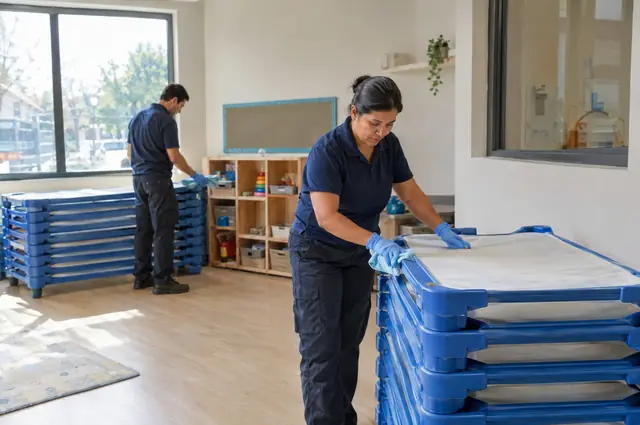
- Clean cribs, cots and mats used by one child (clean shared ones after every use)
- Dust shelves, cubbies, window sills and ledges
- Wipe interior glass, door glass and mirrors at child height
- Spot clean walls and doors around sinks, tables and entries
Bedding soiled with body fluids does not wait for the weekly wash. Appendix K says to launder it with non-chlorine bleach, which it prefers, or bleach, and to dry it completely. The same goes for any sleep surface soiled with body fluids, which gets disinfected right away.
What Goes on the Monthly Daycare Cleaning List?
Monthly tasks are the building-level jobs that keep a center from slowly getting grimy: high dusting, vents, light fixtures, baseboards, deep floor scrubbing and furniture cleaning. Appendix K stops at weekly, but it does set a longer cycle for carpets, saying to steam clean them every 3 to 6 months and spot clean body fluids right away.
- High dust vents, returns, light fixtures and the tops of tall shelves
- Wash baseboards, door frames and cubby faces
- Deep scrub restroom and kitchen floors and grout
- Clean inside the refrigerator, microwave and staff kitchen cabinets
- Wipe down chair legs, table frames and highchair frames
- Check the carpet and hard floor schedule and book the next deep clean
For hard floors, a routine of scrubbing, burnishing and periodic strip and wax keeps vinyl and VCT sealed and easier to keep sanitary. Our commercial floor care crews set that cycle at the walk-through based on traffic. For carpet, our commercial carpet cleaning uses hot water extraction overnight so rooms are dry before children arrive.
The Daycare Cleaning Schedule at a Glance
This table pulls the checklist into one view by frequency. It follows Caring for Our Children Appendix K for the before and after use, daily and weekly columns, and our crew practice for the monthly column. Print it for each room and initial each line as it is done.
| How often | Method | Surfaces and items |
|---|---|---|
| Before and after each use | Clean and sanitize | Food prep counters, meal tables, highchair trays, dishes, bottles, mouthed toys, potty chairs |
| After each use | Clean and disinfect | Diaper changing tables, water tables, shared cribs and cots (clean), anything soiled with body fluids |
| Daily, end of day | Clean and disinfect | Toilets, restroom sinks and counters, diaper pails, restroom floors, drinking fountains, doorknobs, switches, shared keyboards |
| Daily, end of day | Clean | Play centers, counters, shelves, activity tables, floors (sweep or vacuum, then damp mop), carpets (HEPA vacuum) |
| Weekly | Clean or launder | Classroom toys, cloth toys, dress-up clothes, one-child bedding, cots and mats |
| Monthly | Deep clean | Vents, light fixtures, baseboards, deep floor scrub, kitchen appliances, furniture frames |
| Every 3 to 6 months | Steam clean | Carpets, per Appendix K |
Does a Cleaning Schedule Really Reduce Illness?
Cleaning lowers germs on surfaces, and the CDC lists environmental disinfection as one of several outbreak controls, alongside handwashing, safe diapering and keeping sick people home. A CDC-authored 2022 study in Pediatrics covering 2009 to 2020 counted 1,972 acute gastroenteritis outbreaks in U.S. child care facilities from 2009 to 2019 (2020 was analyzed separately), with norovirus and Shigella as the dominant causes.
Those outbreaks lasted a median of 15 days in child care, compared with 9 days in schools, and 85.7% of all the outbreaks studied spread person to person. That is why diapering stations, restroom fixtures and shared toys sit at the top of every checklist.
Cleaning alone is not the whole answer, and the research is honest about that. In a 2015 trial in The Journal of Hospital Infection, twelve Danish nurseries caring for 587 children had toys and linen washed and disinfected every two weeks for three months. Adenovirus, rhinovirus and RSV on surfaces dropped, but the authors found no effect on sickness absence. A checklist works best paired with handwashing and a firm sick policy.
How Phillips Care Cleans Daycares
Daycare cleaning is a split job. Your staff handle the before and after use tasks during the day. Our crew comes in after close, when Ohio's rule keeps deeper cleaning and sanitizing out of occupied rooms, and works through the daily, weekly and monthly lists. The full nightly scope looks a lot like our janitorial checklist, with diapering and toy care added.
Every daycare we take on starts with a free walk-through. We note each room's age group, flooring, restroom count and the products your center already uses, then write a checklist and quote for your building. The same crew comes every visit, products stay labeled and locked in the space you assign, and if something gets missed, the owner takes the call and we fix it. Church nurseries work much the same way, as our church cleaning checklist shows.
Phillips Care Cleaning has served Trumbull and Mahoning County since 2012, insured and bonded, with flat monthly pricing for recurring work. To see how visit frequency changes the price, read what commercial cleaning costs in Warren. To book a walk-through, call (330) 219-7916 or see our daycare cleaning page.
Sources
- CDC, How To Clean and Disinfect Early Care and Education Settings (Apr 19, 2024), retrieved 2026-10-16
- Caring for Our Children, National Resource Center for Health and Safety in Child Care and Early Education, Appendix K: Routine Schedule for Cleaning, Sanitizing, and Disinfecting (updated Jul 25, 2022), retrieved 2026-10-16
- Ohio Administrative Code, Rule 5180:2-12-13, Sanitary equipment and environment for a licensed child care center (effective Jul 1, 2026), retrieved 2026-10-16
- Ohio Administrative Code, Rule 5180:2-12-12, Safe equipment and environment for a licensed child care center (effective Jul 1, 2026), retrieved 2026-10-16
- CDC Stacks, Pediatrics 150(5), Childcare and School Acute Gastroenteritis Outbreaks: 2009 to 2020 (Nov 2022), retrieved 2026-10-16
- The Journal of Hospital Infection 89(2), Effect of cleaning and disinfection of toys on infectious diseases and micro-organisms in daycare nurseries (Feb 2015), retrieved 2026-10-16
Frequently asked questions
Daycare Cleaning Checklist questions, answered.
A free walk-through is the best way to plan your cleaning. These are the questions we hear most from Valley facility managers and owners.
What should be on a daycare cleaning checklist?
A daycare cleaning checklist should cover food areas, diapering and toilet areas, classrooms and toys, sleeping areas, and high-touch surfaces and floors. For each item it should say whether it is cleaned, sanitized or disinfected, and how often: before or after each use, daily, weekly or monthly. The Caring for Our Children Appendix K schedule is the most widely used model for that layout.
How often should daycare toys be cleaned?
Under the Caring for Our Children Appendix K schedule, toys a child has put in their mouth are cleaned and sanitized before another child uses them, using a food-contact-safe sanitizer or a dishwasher. Other classroom toys, washable cloth toys and dress-up clothes are cleaned weekly. Anything soiled with body fluids is cleaned and disinfected right away.
What needs to be cleaned every day in a daycare?
Every day, a daycare should clean and disinfect toilets, restroom sinks and counters, diaper pails, restroom floors, drinking fountains, doorknobs, light switches and shared keyboards. Play centers, counters, shelves and activity tables are cleaned daily, floors are swept or vacuumed and then damp mopped, and carpets are vacuumed, ideally with a HEPA-filter vacuum.
Does Ohio require daycares to be cleaned daily?
Yes. Ohio Administrative Code rule 5180:2-12-13 says a licensed child care center shall be cleaned daily and kept sanitary at all times. Diaper changing stations, potty chairs, food tables and food prep areas must be cleaned and sanitized before reuse, and cleaning and sanitizing should not happen in rooms while children are present, apart from routine cleanup.
What is the difference between sanitizing and disinfecting in child care?
The CDC says sanitizing reduces germs on a surface to levels public health codes consider safe, while disinfecting uses stronger bleach solutions or other chemical products to destroy germs. In a daycare, sanitizing is used on things that touch mouths and food. Disinfecting is used on diaper tables, toilets and anything soiled with body fluids, always after cleaning first.
How often should daycare carpets be deep cleaned?
The Caring for Our Children Appendix K schedule says to vacuum carpets daily with a HEPA-filter vacuum and steam clean them every 3 to 6 months, with spot cleaning right away if carpet is soiled with body fluids. It also notes that washable area rugs are a safer choice than wall-to-wall carpet in child care rooms.
Related services
More from the same crew
Commercial Cleaning
Janitorial, floor care and carpet for offices, churches, daycares, medical offices and shops, on one crew and one invoice.
Explore serviceJanitorial Services
Recurring janitorial contracts: restrooms, trash, dusting and floors on a written checklist, nights or weekends.
Explore serviceCommercial Carpet Cleaning
Hot water extraction for offices, churches, daycares and carpet tile, done overnight so it is dry by morning.
Explore serviceRequest a free quote
One walk-through, one written price, one number to call: (330) 219-7916.
Start the conversation