
Switch Cleaning Companies · Warren, OH
How to Switch Cleaning Companies Without a Gap in Service
A step-by-step plan to change janitorial services, from the notice clause in your current contract to the first night and the first month with the new crew.
Request a Free Walk-ThroughCall (330) 219-7916
Every building starts with a free walk-through and a written checklist and price.
Prefer to talk it through? Call (330) 219-7916, Monday to Friday, 9 to 5.
- Scope built around youA written checklist for your building, not a generic list.
- Planned service windowsNights, weekends or days, around your hours.
- Same crew every visitPeople who learn your building and its priorities.
- Local Valley routesRun from our Warren office since 2012.
To switch cleaning companies without a gap, line up the new company before you cancel the old one. Read your current contract's notice clause, book a walk-through with the new company, get a written checklist and start date, then give notice so the old service ends the night before the new one starts. Finish by collecting keys and alarm codes, and check the new crew weekly for the first month.
Most businesses put off changing janitorial service because they're afraid of a week with overflowing trash and empty soap dispensers. That gap is avoidable. We take over buildings from other cleaning companies around Warren and Youngstown regularly, and the switch goes smoothly when it follows the order below. If you're still deciding what the new service should cover, start with our janitorial checklist and our janitorial services page.
What Are the Signs It's Time to Switch Cleaning Companies?
It's time to switch when the same problems keep coming back after you've reported them. Missed trash, empty restroom supplies, dust building on ledges, a different crew every week, and calls that go unanswered are the common ones. One bad night happens. A pattern that survives two or three complaints means the company can't or won't fix it.
Restrooms are usually where it shows first, and where it costs you most. In a 2024 Bradley Company survey reported by CMM Online, 59% of people said a dirty restroom shows poor management, and 50% said they won't return or will think twice. If clients or patients use your restrooms, a slipping cleaner hurts your business, not just your building.
- The same items are missed again after you've reported them
- Restroom paper, soap or towels run out between visits
- Dust and fingerprints build up on ledges, glass and doors
- You see a different crew every few weeks and have to re-explain the building
- Calls and texts to the company go unanswered or get a manager who can't fix it
- There's no written checklist, so you can't tell what was supposed to happen
- Weekly and monthly jobs like baseboards, high dusting and floor scrubbing never happen
The biggest red flag we hear about on walk-throughs is crew turnover, not dirt. When the person cleaning your building changes every month, nobody learns where the extra trash can is or which door sticks, and quality resets to zero each time. The Bureau of Labor Statistics projects about 321,800 openings for janitors and building cleaners each year through 2035, mostly to replace workers who leave the job. Ask any company you're considering how long its crews stay on the same building.
How Do You Read the Notice Clause in Your Cleaning Contract?
Find the sections called "term," "termination" or "renewal." They tell you how long the contract runs, how many days of written notice you must give, how notice must be delivered, and whether the contract renews on its own. That clause, not the day you're fed up, sets your earliest clean switch date.
Many service contracts are written as automatic renewal or "evergreen" agreements, which roll into a new term unless one side gives notice within a set window before the end date. Hyperstart's 2025 guide to evergreen contracts says notice periods of 30, 60 or 90 days are common. If you miss the window, you may owe another full term. Before you call anyone, write down these four things from your contract:
| What to look for | Where it usually is | Why it matters for the switch |
|---|---|---|
| Term and end date | Term or Agreement Period section | Tells you when you can leave without paying an early exit fee |
| Notice period (days) | Termination or Renewal section | Count back from the end date. That's your deadline to give notice |
| How notice must be sent | Notices section | Some contracts require written notice by mail or email to a named person. A phone call may not count |
| Termination for cause | Termination or Performance section | Some contracts let you end early if service problems are documented and not fixed |
| Equipment and supplies | Supplies or Equipment section | Shows what belongs to the old company and leaves with them on the last night |
If your contract allows termination for poor performance, start documenting now: dates, what was missed, photos, and when you reported it. A short written log turns "they're not doing a good job" into something a contract can act on. Our guide to what to put in a commercial cleaning contract covers the clauses to ask for in your next agreement so you're never stuck like this again.
When Should You Give Notice to Your Current Cleaner?
Give notice only after the new company has walked your building, sent a written checklist and price, and agreed to a start date. Then give the notice your contract requires, timed so the old company's last night falls the night before the new crew's first. That order is what keeps you from going a week with no one cleaning.
Keep the notice short and in writing. State the date the service ends, ask for all keys, fobs and access cards to be returned by that date, and ask them to remove their equipment and any chemicals they own. You don't need to give a reason. A polite, factual email or letter that matches the notice method in your contract is enough.
One thing we always suggest: don't tell the outgoing crew the exact handover date until the paperwork is done. In our experience most crews finish professionally, but a few slack off on the last couple of weeks. Giving the minimum required notice, then checking the building closely during that stretch, protects you either way.
What Happens at the Walk-Through With the New Company?
The walk-through is where the new company learns your building before it gives you a price. Expect them to walk every room, count restrooms, note floor types and high-traffic areas, ask when the building is empty, and ask what the current cleaner is missing. You should leave with a written checklist and a flat price, not a guess.
Use the walk-through to fix whatever went wrong last time. Point out the spots that kept getting missed, the supply closet, the alarm panel and any rooms that are off limits. Ask who will be on your crew, who you call when something is wrong, and how the deeper weekly and monthly jobs are scheduled. Bring your list of past problems and make sure each one appears on the new checklist.
It also helps to ask how the company manages quality. ISSA, the worldwide cleaning industry association, built its Cleaning Industry Management Standard around five areas: quality systems, service delivery, human resources, health and safety and environmental stewardship, and management commitment. A company doesn't need the certificate to run that way, but it should be able to explain how it checks its own work, trains its people and handles a complaint.
How Do You Hand Off Keys, Alarm Codes and Supplies?
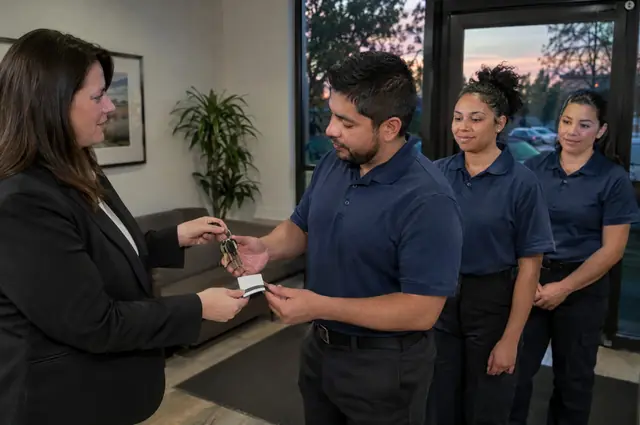
Get every key, fob and access card back from the old company on or before its last night, then change the alarm codes it used the same day. Give the new company its own code, not a shared one, so your alarm log shows who entered. Rekey any lock where a key can't be accounted for.
Supplies take a little sorting. Paper towels, toilet paper, soap and liners may belong to you or to the old cleaner, depending on your contract. Take a quick count of what's on the shelves so the new crew knows what to restock. Chemicals need more care. Under OSHA's Hazard Communication Standard, 29 CFR 1910.1200, employers must keep a Safety Data Sheet for each hazardous chemical in the workplace and keep those sheets readily accessible during each work shift.
The same standard covers buildings where more than one employer's people work. Employers who use or store hazardous chemicals where other employers' workers may be exposed must explain how those workers get the Safety Data Sheets. In plain terms: ask the old company to take its chemicals with it, and ask the new company for SDS sheets for anything it leaves in your closet.
- All keys, fobs and access cards returned and counted against your key log
- Old company's alarm code deleted and new company given its own code
- Locks rekeyed if any key is missing
- Old company's equipment and chemicals removed
- Supply closet counted: paper, soap, liners
- Safety Data Sheets on site for every chemical the new company leaves
- New company has a contact name and number for after-hours problems
How Should You Time the First Night With the New Crew?
Schedule the first night for the evening right after the old company's last visit, on a weekday when someone from your team can stay late or be on call. A manager who can walk the crew through the building, show the alarm panel and answer questions makes that first visit far better than a key left under a mat.
We plan the first visit in a building as a longer night on purpose. Even when the old company was decent, there's usually some catch-up: dust on high ledges, buildup in restroom corners, scuffed baseboards. Expect the first one or two visits to take more time than a normal night, and expect the building to look noticeably better by the end of the first week. If it doesn't, say so right away.
A good first-night handoff covers where the supplies and trash dumpster are, how to arm and disarm the alarm, which doors lock automatically, which rooms are off limits, and who to call if something's broken. Write it on one page and tape it inside the supply closet so it survives crew changes too.
What Should You Check in the First Month?
Check the building yourself the next morning after each of the first few visits, then hold a short weekly check-in with the company for the first four weeks. Compare what you see to the written checklist. Report misses the same day with a photo, and watch whether they are fixed by the next visit. How fast a company fixes small misses in month one tells you how month twelve will go.
| When | What to check |
|---|---|
| Morning after night 1 | Trash, restrooms stocked, floors done, doors locked, alarm set |
| End of week 1 | High-touch points disinfected, break room clean, any first-night misses fixed |
| End of week 2 | First weekly tasks done: detailed dusting, glass, baseboards |
| End of month 1 | Monthly tasks on schedule, same crew each visit, no repeat complaints |
For high-touch surfaces, the CDC lists door handles, counters, stair rails, elevator buttons, touchpads, restroom fixtures and desks as surfaces to clean regularly. It also says a disinfectant has to stay on the surface long enough to kill germs, with the contact time listed on the label and the Safety Data Sheet. If you see a crew spray and wipe immediately, ask about it.
Finally, remember the basics the law expects. OSHA's sanitation standard, 29 CFR 1910.141, says all places of employment shall be kept clean, and every restroom sink needs running water, hand soap and towels or air dryers. Those are the minimums. Your checklist should go well past them.
Is It Hard to Find a Replacement Cleaning Company in the Valley?
No. The Bureau of Labor Statistics counted about 2,380 janitors and cleaners working in the Youngstown-Warren metro in May 2025, so there are options. The work is finding one that will commit to the same crew, a written checklist and an owner or manager you can reach. Ask every company the same questions so you can compare fairly, and check our guide to commercial cleaning costs in Warren before you compare prices.
How Phillips Care Handles a Switch
When you call us, we schedule a free walk-through first, before you say anything to your current cleaner. We walk the building with you, write down what's being missed, and send a written checklist and a flat monthly or per-visit price. Once you approve it, we pick a start date that lines up with your notice period, so there's no gap. The same crew cleans your building every visit, and the owner, Fernando Phillips, takes the call if something isn't right.
We've cleaned offices, churches, daycares and medical offices across Trumbull and Mahoning County since 2012, days, nights or weekends, and we're insured and bonded. See our commercial cleaning services and office cleaning, or call (330) 219-7916 to book your walk-through.
Sources
- U.S. Bureau of Labor Statistics, Occupational Outlook Handbook, Janitors and Building Cleaners (projections 2025 to 2035), retrieved 2026-10-16
- U.S. Bureau of Labor Statistics, May 2025 Metropolitan Area Occupational Employment and Wage Estimates: Youngstown-Warren, OH (Janitors and Cleaners, 37-2011, employment), retrieved 2026-10-16
- OSHA, 29 CFR 1910.1200, Hazard Communication (paragraphs e and g), retrieved 2026-10-16
- OSHA, 29 CFR 1910.141, Sanitation, retrieved 2026-10-16
- CDC, When and How to Clean and Disinfect a Facility (Apr 16, 2024), retrieved 2026-10-16
- CMM Online, Unclean restrooms show poor management, survey shows (Bradley, Aug 2024), retrieved 2026-10-16
- FMLink, ISSA releases Cleaning Industry Management Standard (Nov 27, 2006), retrieved 2026-10-16
- Hyperstart, Evergreen Contracts: The Complete Guide for Legal Teams and Business Leaders (Sep 30, 2025), retrieved 2026-10-16
Frequently asked questions
Switch Cleaning Companies questions, answered.
A free walk-through is the best way to plan your cleaning. These are the questions we hear most from Valley facility managers and owners.
How do I switch cleaning companies without a gap in service?
Line up the new company first. Book a walk-through, get a written checklist and price, and agree on a start date. Then give your current company the notice your contract requires, timed so its last night is the night before the new crew starts. Collect keys and change alarm codes on the handover day, and check the building closely for the first month.
How much notice do I need to give my cleaning company?
It depends on your contract. Look for the termination or renewal section, which states the notice period and how notice must be sent. Hyperstart's 2025 guide to evergreen contracts says 30, 60 or 90 days is common, and many service contracts renew automatically if you miss the window. If there's no written contract, give written notice anyway so the end date is clear.
What should I say when I cancel my cleaning service?
Keep it short, polite and in writing. Say the date the service will end, ask for all keys, fobs and access cards to be returned by that date, and ask them to remove their equipment and chemicals. You don't need to give a reason. Send it by the method your contract requires, such as email or mail to a named person.
Can I cancel a cleaning contract early for poor service?
Some contracts allow termination for cause when service problems are documented and not corrected. Check the termination or performance section. Keep a written log with dates, what was missed, photos and when you reported it. That record gives you something concrete to point to if the contract has a performance clause, and it helps if there's a dispute.
Should I change my alarm codes when I change cleaning companies?
Yes. Collect every key, fob and access card from the old company, delete its alarm code the same day, and give the new company its own code so your alarm log shows who entered. If any key can't be accounted for, rekey that lock. It's a small cost compared with an unknown key to your building.
How long does it take to switch janitorial services?
Plan on the length of your notice period plus a few days. The walk-through, written checklist and price can usually be done within a few days of your first call. After that, the timing is set by how much notice your current contract requires. The handover itself happens in one night if keys, codes and supplies are planned ahead.
Related services
More from the same crew
Janitorial Services
Recurring janitorial contracts: restrooms, trash, dusting and floors on a written checklist, nights or weekends.
Explore serviceCommercial Cleaning
Janitorial, floor care and carpet for offices, churches, daycares, medical offices and shops, on one crew and one invoice.
Explore serviceOffices & Multi-Tenant
Desks, restrooms, break rooms and shared areas cleaned after hours on a written checklist.
Explore serviceRequest a free quote
One walk-through, one written price, one number to call: (330) 219-7916.
Start the conversation