
Medical Office Cleaning Checklist · Warren, OH
Medical Office Cleaning Checklist: Room by Room and How Often
What to clean in the waiting room, check-in, exam rooms, restrooms, staff areas and floors, how often, and the CDC and EPA guidance behind it.
Request a Free Walk-ThroughCall (330) 219-7916
Every building starts with a free walk-through and a written checklist and price.
Prefer to talk it through? Call (330) 219-7916, Monday to Friday, 9 to 5.
- Scope built around youA written checklist for your building, not a generic list.
- Planned service windowsNights, weekends or days, around your hours.
- Same crew every visitPeople who learn your building and its priorities.
- Local Valley routesRun from our Warren office since 2012.
A medical office cleaning checklist lists every room in the practice, says what gets cleaned and what gets disinfected, and says how often: nightly, weekly or monthly. High-touch points like door handles, check-in counters, exam room chairs and restroom fixtures are disinfected every night with an EPA-registered product left wet for its full contact time. Floors, glass, vents and baseboards rotate on a weekly and monthly cycle.
We clean offices, churches, daycares and medical suites around Warren and Youngstown. A medical office is the building where the written list matters most, because the practice's infection prevention plan already expects one. Below is the checklist our crews work from, sorted by area and frequency and built on the CDC and EPA guidance. If you want a crew to run it, see our medical office cleaning service.
What Should a Medical Office Cleaning Checklist Include?
A complete medical office cleaning checklist covers six areas: the waiting room, the check-in desk, exam rooms, restrooms, staff areas and floors. For each item it names the method, clean or clean and disinfect, and the timing, nightly, weekly or monthly. It also names who does it, because some tasks belong to clinical staff and some to the cleaning crew.
The CDC's Guide to Infection Prevention for Outpatient Settings (Version 2.3, September 2016, the version on CDC's current page) says outpatient facilities should establish policies and procedures for routine cleaning and disinfection of environmental surfaces as part of their infection prevention plan. Its companion checklist asks whether the facility has written procedures, including identification of responsible personnel. A room by room list with names and frequencies is the simplest way to answer yes.
The same checklist adds a note that matters when you hire out the work: if environmental cleaning is performed by contract personnel, the facility should verify that the contracting company provides the training. Ask any cleaning company how it trains crews on your procedures before the first night.
What Do CDC Guidelines Say About Cleaning a Medical Office?
The CDC's Guidelines for Environmental Infection Control in Health-Care Facilities (2003, page updated January 8, 2024) divide housekeeping surfaces into two groups. Surfaces with minimal hand contact, like floors and ceilings, need regular cleaning. High-touch surfaces in patient-care areas "should be cleaned and/or disinfected more frequently than surfaces with minimal hand contact."
The guideline gives doorknobs, bedrails and light switches as high-touch examples. It also says cleaning solutions should be replaced frequently, soiled cloths and mop heads swapped for clean ones whenever the bucket is changed, and leftover solution discarded rather than saved for tomorrow. Methods that produce minimal mists, aerosols or dust in patient-care areas are preferred.
The outpatient guide adds two rules that shape every line below. Cleaning removes visible soil and "must always precede disinfection." And disinfectant products should not be used as cleaners unless the label says the product is suitable for that use.
What Is EPA List N and Why Does Contact Time Matter?
List N is the EPA's list of disinfectants it expects to kill SARS-CoV-2 when used according to the label directions (page last updated September 15, 2026). The label also lists a contact time, the minutes the product must sit on the surface. EPA's "Six Steps for Safe and Effective Disinfectant Use" says the surface should remain wet the whole time.
To check a product, the EPA page says to find the EPA Reg. No. on the label and enter the first two sets of numbers into its search tool. The CDC outpatient guide goes a step further for medical offices: select EPA-registered disinfectants or detergent and disinfectant products with label claims for use in healthcare, and follow the manufacturer's directions for amount, dilution, contact time, safe use and disposal.
| Step | What it does | Where it is used in a medical office |
|---|---|---|
| Clean | Detergent, water and wiping remove visible soil and many germs | Every surface, every time, before any disinfectant goes on |
| Disinfect | An EPA-registered product kills germs when left wet for the label contact time | Door handles, check-in counters, exam room chairs and counters, restroom fixtures, shared phones and keyboards |
| Clean only | Detergent and water are enough for low-touch areas | Floors in general areas, walls, ceilings, blinds when visibly soiled |
The mistake we see most is a disinfectant sprayed and wiped dry in a few seconds. The counter looks clean but never got the contact time printed on the label, which can run several minutes depending on the product. Our crews write the contact time of each product your practice uses at the top of the checklist and work in a set order, so a surface stays wet while the next one gets sprayed.
Waiting Room Cleaning Checklist
The waiting room has the most hands and the most seats, and it is the first thing patients judge. Chair arms, side tables, door handles and the check-in pen cup get touched by every visitor, so they go on the nightly disinfect list. Magazines, toys and fabric items are the hard part, and many practices have pulled them for that reason.
- Clean, then disinfect chair arms, chair backs and side tables
- Disinfect entry door handles, push plates and light switches
- Clean and disinfect children's play tables and any hard toys the practice keeps out
- Wipe the water cooler, hand sanitizer stations and their drip trays, and report any empty dispenser
- Empty trash and replace liners
- Clean entry glass and door glass inside and out
- Vacuum carpet and mats with a HEPA-filter vacuum, and damp mop hard floors
Check-In Desk and Front Office Checklist
The check-in counter is where patients lean, sign and hand over cards, and it sits next to staff keyboards and phones. It gets a nightly clean and disinfect. Paperwork, charts and screens stay exactly where staff left them; the crew cleans around them and never moves or reads them.
- Clean and disinfect the check-in counter, the transaction window ledge and any clipboard tray
- Disinfect pens, card readers and patient-facing tablets per the practice's product list
- Wipe staff phones, keyboards and mice with a product the practice approves for electronics
- Dust monitors, printers and file cabinet tops without moving papers
- Empty desk trash and the shred bin only if the practice assigns it to the crew
How Should Exam Rooms Be Cleaned After Hours?
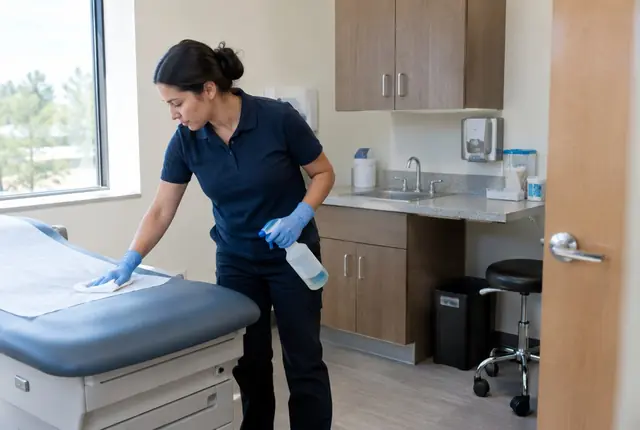
After hours, exam rooms get a top to bottom clean and disinfect of every surface patients and staff touch: the counter, sink, faucet, cabinet pulls, chairs, door handles, light switches and the exam table surfaces the practice assigns to the crew. Between-patient wipe-downs of the exam table and clinical equipment stay with the practice's own staff.
- Clean and disinfect countertops, sinks, faucets and soap and towel dispensers
- Disinfect cabinet and drawer pulls, door handles and light switches
- Clean and disinfect patient and provider chairs and stools
- Clean the exam table base and step, and the table top if the practice assigns it
- Wipe exterior surfaces of wall-mounted equipment only as the practice directs
- Empty regular trash and replace liners; leave sharps containers and red bags for staff
- Restock paper towels, soap and glove boxes from the practice's supply
- Damp mop the floor, working from the far corner to the door
The CDC outpatient guide puts its emphasis on surfaces most likely to become contaminated, including those close to the patient and frequently touched surfaces in the patient-care environment.
What Belongs on the Medical Office Restroom Checklist?
Restrooms get cleaned and disinfected every night: toilets, urinals, seats, sinks, faucets, flush handles, grab bars, door handles and stall latches. Floors around the toilets are cleaned and disinfected, dispensers are refilled, and trash and sanitary bins are emptied. A busy practice may also need a midday restroom check by staff or a day porter.
- Clean and disinfect toilets, seats, urinals and flush handles
- Clean and disinfect sinks, faucets, counters and grab bars
- Disinfect door handles, stall latches and light switches
- Clean mirrors and stainless dispensers
- Refill toilet tissue, soap and paper towels
- Empty trash and sanitary bins and replace liners
- Mop the floor with a mop head used only in restrooms, then disinfect around fixtures
- Pour water down floor drains weekly so traps do not dry out
What Gets Cleaned in Staff Areas and Break Rooms?
Staff areas include the break room, provider offices, the nurse station and the hallway. They get a nightly clean of counters, tables, sinks and appliance handles, a disinfect of high-touch points, trash removal and floor care. Weekly, the crew cleans the microwave and refrigerator exteriors and dusts ledges and shelves.
- Clean and disinfect break room tables, counters, sink and faucet
- Disinfect refrigerator, microwave and coffee maker handles
- Clean nurse station counters around, never on, charts and medication areas
- Disinfect hallway handrails, door handles and elevator buttons
- Empty trash and recycling, and load or run the dishwasher if asked
- Vacuum provider offices and dust desks around papers
Most practices have a clean utility room, a soiled utility room and a medication area that the crew should not enter or should only mop. We mark those doors on the floor plan at the walk-through and write "do not enter" or "floor only" on the checklist, so a new crew member on a fill-in night does not have to guess.
How Should Medical Office Floors Be Cleaned?
Medical office floors are cleaned nightly with detergent and water by damp mopping hard floors and vacuuming carpet, with a disinfectant used around restroom fixtures and on spills. The CDC's 2003 guideline says extraordinary cleaning and decontamination of floors in health-care settings is unwarranted, and that disinfecting floors offers no advantage over regular detergent and water cleaning.
The same guideline lists wet mopping and wet vacuuming as methods for non-porous floors, says vacuums should be equipped with HEPA filters, especially in high-risk patient-care areas, and calls avoiding carpet prudent where spills are likely, such as near sinks. For vinyl and VCT, a cycle of scrubbing, burnishing and periodic strip and wax keeps the finish sealed and easier to keep clean. Our commercial floor care crews set that cycle at the walk-through based on traffic.
The Medical Office Cleaning Schedule at a Glance
This table pulls the checklist into one view by frequency. The nightly rows follow the CDC split between high-touch and low-touch surfaces. The weekly and monthly rows are our crew practice. Print it for each area and initial each line as it is done.
| How often | Method | Surfaces and items |
|---|---|---|
| Nightly | Clean and disinfect | Door handles, switches, check-in counter, waiting room chair arms and tables, exam room counters, sinks and chairs, restroom fixtures, shared phones and keyboards |
| Nightly | Clean | Trash and liners, glass at entries, break room surfaces, hard floors (damp mop), carpet (HEPA vacuum) |
| Weekly | Clean | Dust ledges, shelves, vents within reach and picture frames; clean appliance exteriors; wipe baseboards in high-traffic halls; run floor drains |
| Monthly | Deep clean | High dust vents and light fixtures, wash all baseboards, deep scrub restroom floors and grout, clean blinds when soiled, spot clean walls |
| Quarterly or as scheduled | Floor care | Machine scrub and burnish hard floors, hot water extraction on carpet, strip and wax VCT on the agreed cycle |
A nightly list like this sits close to a standard office scope. For comparison, see our janitorial checklist and our office cleaning page.
What Stays With the Practice's Clinical Staff?
Sharps containers, regulated medical waste, blood and body fluid spills, clinical equipment and between-patient wipe-downs stay with the practice's trained clinical staff. The OSHA bloodborne pathogens standard, 29 CFR 1910.1030, puts the employer in charge of a written cleaning schedule and decontamination method for those exposures and work surfaces.
That standard says contaminated work surfaces shall be decontaminated with an appropriate disinfectant after completion of procedures, and it defines regulated waste to include contaminated sharps and items caked with blood or other potentially infectious materials. Our crews do not handle any of it. They empty regular trash, leave red bags and sharps containers in place, and follow the practice's own procedures for anything else in the room.
Write that split into your cleaning agreement so nobody is unsure on a busy Friday. Our guide to what to put in a commercial cleaning contract covers scope lines, frequencies and how missed items get fixed.
How Phillips Care Cleans Medical Offices
Medical office cleaning is a split job. Your staff handle the between-patient work during the day. Our crew comes in after close and works through the nightly, weekly and monthly lists, using the products your practice approves and the contact times on their labels.
Every practice we take on starts with a free walk-through. We note each room, the flooring, the restroom count, the products already on your shelves and the doors that are off limits, then write a checklist and quote for your building. Crews follow your practice's own procedures, the same crew comes every visit, and if something gets missed, the owner takes the call and we fix it.
Phillips Care Cleaning has served Trumbull and Mahoning County since 2012, insured and bonded, with flat monthly or per-visit pricing for recurring work and cleaning days, nights or weekends. To book a walk-through, call (330) 219-7916 or see our medical office cleaning page.
Sources
- CDC, Guidelines for Environmental Infection Control in Health-Care Facilities (2003): Environmental Services (page updated Jan 8, 2024), retrieved 2026-10-16
- CDC, Guide to Infection Prevention for Outpatient Settings: Minimum Expectations for Safe Care, Version 2.3 (Sep 2016; page dated Sep 30, 2025), retrieved 2026-10-16
- U.S. EPA, About List N: Disinfectants for Coronavirus (COVID-19) (last updated Sep 15, 2026), retrieved 2026-10-16
- U.S. EPA, Six Steps for Safe and Effective Disinfectant Use (last updated Apr 1, 2026), retrieved 2026-10-16
- OSHA, 29 CFR 1910.1030, Bloodborne Pathogens, retrieved 2026-10-16
Frequently asked questions
Medical Office Cleaning Checklist questions, answered.
A free walk-through is the best way to plan your cleaning. These are the questions we hear most from Valley facility managers and owners.
What should be on a medical office cleaning checklist?
A medical office cleaning checklist should cover the waiting room, check-in desk, exam rooms, restrooms, staff areas and floors. For each item it should say whether it is cleaned or cleaned and disinfected, how often, and who does it. The CDC outpatient guide expects written procedures that name the responsible personnel, so a room by room list with frequencies covers that.
How often should a medical office be cleaned?
Most medical offices need cleaning every night they are open. High-touch surfaces like door handles, counters, exam room chairs and restroom fixtures are cleaned and disinfected nightly. Dusting, baseboards and appliance cleaning rotate weekly or monthly, and hard floor and carpet care runs on a longer cycle set by traffic. Between-patient wipe-downs are done by clinical staff during the day.
What disinfectant should a medical office use?
The CDC Guide to Infection Prevention for Outpatient Settings says to select EPA-registered disinfectants or detergent and disinfectant products with label claims for use in healthcare. Follow the manufacturer's directions for amount, dilution, contact time, safe use and disposal. You can check a product by entering its EPA registration number in EPA's List N search tool.
What is disinfectant contact time?
Contact time is how long a disinfectant must stay on a surface to work, and it is printed in the label directions. EPA's Six Steps for Safe and Effective Disinfectant Use says the surface should remain wet the whole time. A spray that is wiped dry right away has not met the contact time, so the surface was cleaned but not disinfected.
Do medical office floors need to be disinfected?
Not usually. The CDC's Guidelines for Environmental Infection Control in Health-Care Facilities say extraordinary cleaning and decontamination of floors is unwarranted and that disinfecting floors offers no advantage over regular detergent and water cleaning. Spills, restroom floors around fixtures and anything contaminated with blood or body fluids are the exceptions and are handled under the practice's procedures.
Does a cleaning company handle medical waste?
A janitorial crew handles regular trash, not regulated medical waste. Under the OSHA bloodborne pathogens standard, regulated waste includes contaminated sharps and items caked with blood or other potentially infectious materials, and the practice is responsible for its written cleaning and decontamination plan. Phillips Care crews leave sharps containers and red bags in place and follow the practice's own procedures.
Related services
More from the same crew
Medical & Dental Offices
Waiting rooms, exam rooms and restrooms cleaned after patients leave.
Explore serviceOffices & Multi-Tenant
Desks, restrooms, break rooms and shared areas cleaned after hours on a written checklist.
Explore serviceCommercial Floor Care
Scrubbing, stripping, waxing and burnishing on a schedule that keeps VCT, vinyl and tile floors shining.
Explore serviceRequest a free quote
One walk-through, one written price, one number to call: (330) 219-7916.
Start the conversation