
How Often to Clean Gutters · Warren, OH
How Often Should Gutters Be Cleaned in Ohio?
A twice-a-year baseline, how trees and Northeast Ohio winters change it, the signs of a clog and when to leave the ladder to someone else.
Request a Free Walk-ThroughCall (330) 219-7916
Every home starts with a free walk-through and a written checklist and price.
Prefer to talk it through? Call (330) 219-7916, Monday to Friday, 9 to 5.
- Scope built around youA written checklist for your home, not a generic list.
- Planned service windowsNights, weekends or days, around your hours.
- Same crew every visitPeople who learn your home and its priorities.
- Local Valley routesRun from our Warren office since 2012.
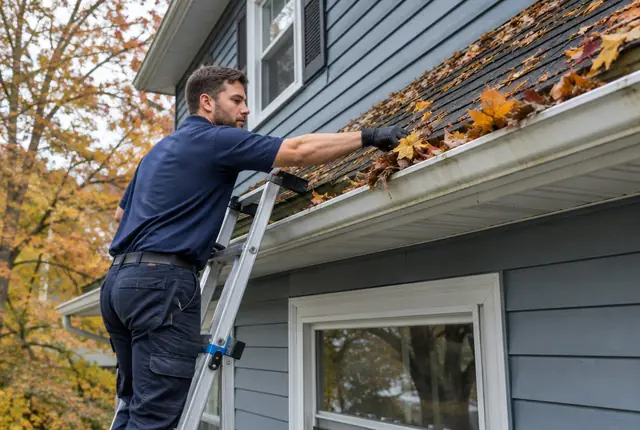
Most homes should have their gutters cleaned at least twice a year: once in spring and once in late fall after the leaves drop. Homes under big trees, especially oaks, maples and pines, often need a third cleaning. In Northeast Ohio the late fall cleaning matters most, because gutters that go into winter full of leaves can't drain melting snow and are more likely to freeze into ice dams.
We clean gutters on homes, rentals and small commercial buildings across Trumbull and Mahoning County, and the question we hear most is "how often do I really need this?" Below is the schedule by property type, what Valley weather does to it, the signs of a clog, and the ladder safety numbers that make a lot of people hand the job off. If yours are already overflowing, see our gutter cleaning page.
How Often Should Gutters Be Cleaned?
The common baseline is twice a year. In March 2025, Tower Hill Insurance wrote that experts recommend cleaning gutters at least twice a year, typically in the spring and fall, and more often with overhanging trees or frequent storms. That is a minimum, not a fixed rule. The right number for your house depends on what grows above the roof.
Gutters fill from more than leaves. Seeds, twigs, pine needles, shingle grit and windblown dirt all settle in the trough and wash toward the downspout, where they pack into a plug. Once that plug forms, every rain overflows the gutter instead of draining it. InterNACHI, the home inspectors' trade association, says regular gutter system maintenance is necessary to prevent moisture intrusion problems, and notes that excess water can wick through a foundation and lead to mold and wood rot.
| Property | Suggested cleanings per year | When |
|---|---|---|
| No trees near the roof | 1 to 2 | Late fall, plus spring if you see grit or overflow |
| A few trees nearby | 2 | Spring (April or May) and late fall (November) |
| Large trees over the roof | 3 | Spring, early fall and late fall after the last leaves |
| Pines over the roof | 3 to 4 | Every season, since needles drop year round |
| Rental or small commercial building | 2 | Spring and late fall on a set schedule |
| Gutter guards installed | 1 check or cleaning | Late fall, plus after major storms |
The table is our recommendation, built from the twice-a-year baseline and what we pull out of gutters on Valley properties each season. Adjust it once you see how fast your own gutters fill.
When Should You Clean Gutters in Northeast Ohio?
Plan on late spring and late fall. The fall cleaning should come after most leaves are down, which in our area usually means November. On October 2, 2026, Spectrum News reported that the Ohio Department of Natural Resources expected fall color to peak in mid-to-late October for the rest of northern and central Ohio, so leaf drop runs into November.
Cleaning too early is the most common timing mistake we see. A homeowner clears the gutters in the second week of October, the oaks and maples let go two weeks later, and the gutters go into December just as full as before. If your yard has big trees, either wait until the branches are mostly bare or plan on two fall visits: one in late October and one before Thanksgiving. Spring is about seeds. Maple helicopters and tree flowers come down in April and May and can clog a gutter that looked clean in November.
Winter is the season that punishes a missed fall cleaning. NOAA's 1991 to 2020 climate normals put average snowfall at Youngstown-Warren Regional Airport at 67.8 inches a year. That snow melts and refreezes many times a season, and every melt needs a clear path off the roof.
How Do Trees Change the Schedule?
Trees are the biggest reason a house needs more than two cleanings. Tower Hill Insurance says homes with overhanging trees may need cleaning more often to prevent blockages, and InterNACHI notes that trees may shed their leaves onto the roof and into the gutters. Count the trees whose branches reach over your roofline, then look at what kind they are.
- Oaks: drop leaves late, often into December, plus acorns and catkins in spring
- Maples: heavy leaf drop in fall and helicopter seeds in spring
- Pines and spruce: needles fall all year and slip through many guards
- Cottonwoods and sycamores: big leaves and fluff that mat into a dense layer
- No trees, but nearby fields: windblown dirt and shingle grit still build up over a year
A one-story ranch with no trees near the roof can sometimes go a year between cleanings. A two-story colonial under mature oaks in Howland or Canfield may need three. The house, not the calendar, sets the schedule.
Why Clogged Gutters Make Ice Dams Worse
An ice dam forms when warm attic air melts roof snow, the water runs down to the cold roof edge and refreezes there. North Dakota State University Extension, in a January 4, 2023 release, explains that the ridge of ice then backs up more meltwater, which can leak under the shingles and cause ceiling stains, structural damage and mold.
Gutters don't cause ice dams, but clogged ones make them harder to escape. The National Weather Service Grand Rapids office advises homeowners to thoroughly clean all leaves, sticks and other debris from gutters and downspouts so that melting roof snow can flow into the gutters and through the downspouts, and to keep them clear of snow and icicles all winter. A gutter packed with wet leaves freezes solid and gives the dam a head start.
The fix for the cause lives in the attic. University of Missouri Extension specialist Bob Schultheis said in December 2017 that the best way to prevent ice dams is to control heat loss from your home through insulation, air sealing and ventilation. ENERGY STAR's insulation guide, based on the 2021 International Energy Conservation Code, recommends R-49 to R-60 in the attic for Ohio's climate zones (R-60 for an uninsulated attic, R-49 added on top of 3 to 4 inches already there). Missouri Extension also lists sagging gutters among the damage ice dams leave behind.
What Are the Signs Your Gutters Need Cleaning?
Water spilling over the gutter edge during a normal rain is the clearest sign. Others are plants growing out of the trough, gutters pulling away from the fascia, stains on siding below the gutter, a downspout that barely trickles in a storm, and wet spots or erosion along the foundation. Any one of these means it's time.
- Water sheets over the front edge of the gutter when it rains
- Seedlings, moss or grass growing in the gutter
- Gutter sags or pulls away from the house between hangers
- Dark streaks or stains on siding or brick under the gutter line
- Little or no water comes out of the downspout during a storm
- Puddles, washed-out mulch or erosion along the foundation
- Damp spots in the basement after heavy rain
- Icicles along the gutters or wet ceiling spots near outside walls in winter
The downspout is where most clogs actually live. Debris washes along the trough and jams in the elbow at the top of the downspout or the bend at the bottom. From the ground the gutter can look clear while the downspout is packed solid. That's why we flush every downspout with water after clearing the trough, and why a gutter that overflows right at the corner usually points to a blocked downspout, not a full gutter.
Downspouts Should Send Water Away From the Foundation
A clean gutter only helps if the downspout carries the water away from the house. InterNACHI tells home inspectors to check that downspouts divert water 4 to 6 feet away from the foundation. University of Georgia Extension's Mold and Moisture Home Inspection Checklist, reviewed March 1, 2023, goes further and says downspouts should extend 6 to 10 feet from the foundation.
Short downspouts that dump water right at the wall undo the work of the gutter. Extensions, splash blocks or buried drain lines all help. The same UGA checklist says gutters and downspouts should be intact, free of debris and direct water away from the house. If your basement gets damp after storms, check the downspout outlets before anything else.
How Dangerous Is Cleaning Gutters Yourself?
The gutter itself is easy. The ladder is the risk. A study in the American Journal of Preventive Medicine, announced by Nationwide Children's Hospital on May 1, 2007, found more than 2.1 million people were treated in U.S. emergency departments for ladder injuries from 1990 through 2005, about 136,000 a year, and 97 percent of cases with a known location happened outside of work.
Those are homeowners at home, not roofers on job sites. The same study found nearly 10 percent of the injuries led to hospitalization or transfer, and fractures were the most common injury. Age raises the risk. The U.S. Consumer Product Safety Commission's Home Safe outdoor repairs checklist (2020) names gutter cleaning as a common ladder job and says people 65 and older are 80 percent more likely than other adults to visit an emergency room for injuries involving ladders or stools.
Height matters less than people think. The CDC's 2014 MMWR report on work-related ladder falls found that nearly 90 percent of nonfatal falls were from under 16 feet, and falls of 6 to 10 feet made up half of the ER-treated cases. That's a single-story gutter.
Ladder Safety Rules If You Clean Your Own Gutters
If you do it yourself, set up carefully and never work alone. The CPSC's Home Safe checklist says to have someone spot you, set the ladder on stable ground, never stand on the top rung and keep the ladder away from power lines. A CPSC ladder safety post adds that an extension ladder should reach at least 3 feet past the roofline.
- Have a helper hold the bottom of the ladder (CPSC)
- Set the ladder on level, firm ground, using leg levelers on soft soil (CPSC)
- Set an extension ladder at about a 75 degree angle (CPSC)
- Stay off the top three rungs of an extension ladder (CPSC)
- Keep your body centered between the rails and move the ladder instead of leaning
- Keep metal ladders away from the service line to the house
- Wear gloves, since gutters hide sharp screws, metal edges and broken glass
- Skip the job when the roof or ground is wet, icy or windy
Never climb onto an icy roof to chip at an ice dam. NDSU Extension recommends pulling snow off the lower roof with a roof rake from the ground and staying clear of overhead power lines.
Do Gutter Guards Mean You Never Clean Again?
No. Guards cut down how often you clean, but they don't end it. InterNACHI says covered gutter systems may be effective in preventing excessive debris buildup, but these are not maintenance-free. Fine debris like pine needles, seeds and shingle grit still gets through or sits on top of the screen.
What we find under guards is a layer of black sludge. Small particles slip through the mesh, settle in the trough and break down into a muck that holds water. On top of the screen, wet leaves can mat down and send rain right over the edge. A guarded gutter usually needs a check and a cleaning once a year, in late fall, and the screens have to come off to do it right. If you're shopping for guards, ask how they come off for cleaning.
How Phillips Care Cleans Gutters
We clear gutters by hand, flush every downspout, check that water flows from end to end, and bag and haul away the debris instead of leaving it in your flower beds. If we see loose hangers, a gutter pulling away or a downspout dumping at the foundation, we point it out. Rentals and small commercial buildings can go on a set twice-a-year schedule.
Many customers pair the fall visit with other outdoor work. Window cleaning fits well after the gutters are done, and spring is a good time for pressure washing to clear the streaks overflowing gutters leave on siding. Our guide on how often to pressure wash a house covers that schedule, and our deep cleaning checklist handles the inside. We're based in Warren, insured and bonded, and the owner takes the call. Call (330) 219-7916 or request a free quote.
Sources
- Tower Hill Insurance, How Often Should You Clean Your Gutters? (Mar 20, 2025), retrieved 2026-10-16
- Spectrum News 1 (reporting ODNR), Fall colors begin to pop up across Ohio (Oct 2, 2026), retrieved 2026-10-16
- NOAA National Centers for Environmental Information, U.S. Climate Normals 1991-2020, Youngstown-Warren Regional Airport (USW00014852), annual snowfall normal 67.8 inches, retrieved 2026-10-16
- National Weather Service Grand Rapids, Preventing Roof Ice Dams, retrieved 2026-10-16
- North Dakota State University Extension, Reduce ice dam and icicle damage (Jan 4, 2023), retrieved 2026-10-16
- University of Missouri Extension, Ice dams on the roof can damage your home (Dec 7, 2017), retrieved 2026-10-16
- ENERGY STAR, Recommended Home Insulation R-Values, retrieved 2026-10-16
- InterNACHI, Inspecting Gutters and Downspouts, retrieved 2026-10-16
- University of Georgia Extension, Mold and Moisture Home Inspection Checklist, Circular 1083 (reviewed Mar 1, 2023), retrieved 2026-10-16
- Nationwide Children's Hospital (American Journal of Preventive Medicine study), Ladder-Related Injuries Increasing in the U.S. (May 1, 2007), retrieved 2026-10-16
- U.S. Consumer Product Safety Commission, Home Safe: Outdoor Repairs checklist (2020), retrieved 2026-10-16
- U.S. Consumer Product Safety Commission, Ladder Safety 101, OnSafety blog (Dec 3, 2011), retrieved 2026-10-16
- CDC, MMWR, Occupational Ladder Fall Injuries, United States, 2011 (Apr 25, 2014), retrieved 2026-10-16
Frequently asked questions
How Often to Clean Gutters questions, answered.
A free walk-through is the best way to plan your cleaning. These are the questions we hear most from Valley homeowners.
How often should gutters be cleaned?
At least twice a year, in spring and late fall, for most homes. Tower Hill Insurance gave that baseline in March 2025 and said overhanging trees or frequent storms call for more. Homes under large oaks, maples or pines often need three cleanings a year, and a house with no trees nearby can sometimes go a full year between cleanings.
What month should I clean my gutters in Ohio?
In Northeast Ohio, plan on April or May for the spring cleaning and November for the fall cleaning, after most leaves are down. ODNR expected 2026 fall color to peak in mid-to-late October across northern Ohio, so cleaning in early October often means the gutters fill again before winter. Heavily wooded lots may need a second fall visit.
Can clogged gutters cause ice dams?
Clogged gutters don't cause ice dams by themselves, but they make them worse. Ice dams start when attic heat melts roof snow and the water refreezes at the cold edge. The National Weather Service advises cleaning leaves and debris from gutters and downspouts so melting snow can drain. A gutter full of frozen leaves gives the ice a head start.
What happens if you never clean your gutters?
Water overflows during rain and lands at the foundation, which can lead to basement leaks, eroded soil and stained siding. InterNACHI notes that excess water can wick through a foundation and cause mold and wood rot. Full gutters also get heavy, pull away from the fascia and freeze in winter, which can damage the gutter and the roof edge.
Do gutter guards really work?
They reduce how often gutters need cleaning, but they don't eliminate it. InterNACHI says covered gutter systems may be effective in preventing excessive debris buildup but are not maintenance-free. Pine needles, seeds and shingle grit can pass through or mat on top of screens. Plan on checking and cleaning guarded gutters at least once a year, usually in late fall.
Is it safe to clean gutters yourself?
It can be, with a sound ladder, a helper and dry weather, but ladder falls are common. A study in the American Journal of Preventive Medicine counted more than 2.1 million ladder injuries treated in U.S. emergency rooms from 1990 to 2005, mostly outside of work. The CPSC says people 65 and older are 80 percent more likely than other adults to go to the ER for ladder injuries.
Related services
More from the same crew
Gutter Cleaning
Gutters and downspouts cleared by hand and flushed, so water goes where it should.
Explore serviceWindow Cleaning
Streak-free windows, frames and sills, inside and out, for storefronts and homes.
Explore servicePressure Washing
Driveways, sidewalks, siding and storefronts washed clean of dirt, mildew and grime.
Explore serviceRequest a free quote
One walk-through, one written price, one number to call: (330) 219-7916.
Start the conversation