
Deep Cleaning Checklist · Warren, OH
Deep Cleaning Checklist: Room by Room, Top to Bottom
Every task a real deep clean covers, room by room, in the order that saves you from cleaning anything twice.
Request a Free Walk-ThroughCall (330) 219-7916
Every home starts with a free walk-through and a written checklist and price.
Prefer to talk it through? Call (330) 219-7916, Monday to Friday, 9 to 5.
- Scope built around youA written checklist for your home, not a generic list.
- Planned service windowsNights, weekends or days, around your hours.
- Same crew every visitPeople who learn your home and its priorities.
- Local Valley routesRun from our Warren office since 2012.
A deep cleaning checklist is a room by room list of the jobs a regular cleaning skips: inside the oven and fridge, behind and under furniture, baseboards, vents, light fixtures, grout, window tracks and upholstery. Work each room top to bottom, finish with the floors, and plan on a deep clean taking several times longer than a normal weekly clean.
Most people deep clean once a year, usually in spring. The American Cleaning Institute's 2024 survey, run by Wakefield Research, found 80% of Americans plan to spring clean, and 45% say the job takes three or more days. The checklist below is the one our crews work from when we deep clean homes across Warren, Youngstown and the rest of Trumbull and Mahoning County. Use it yourself, or hand it to us through our house cleaning service.
What Is the Difference Between Deep Cleaning and Regular Cleaning?
Regular cleaning maintains the surfaces you see and touch every week: counters, sinks, toilets, floors and dusting at eye level. Deep cleaning goes inside, behind, under and up high, removing the buildup that weekly cleaning never reaches. A regular clean keeps a home tidy. A deep clean resets it.
| Task | Regular cleaning | Deep cleaning |
|---|---|---|
| Kitchen counters and sink | Wiped and cleaned | Scrubbed, plus backsplash, faucet base and drain |
| Appliances | Fronts wiped | Inside oven, microwave and fridge, plus pulled out where possible |
| Bathrooms | Toilet, sink, tub and mirror cleaned | Soap scum, grout, fixtures, exhaust fan and behind the toilet |
| Dusting | Open surfaces at eye level | Ceiling fans, light fixtures, vents, door frames, blinds and baseboards |
| Furniture | Dusted around | Moved where possible, cleaned under and behind, upholstery vacuumed |
| Floors | Vacuumed and mopped | Edges and corners detailed, under furniture, grout and carpet treated |
| Windows | Smudges spot cleaned | Glass, sills, tracks and screens cleaned |
Price follows the work. Housecall Pro's house cleaning price guide puts a standard cleaning at $140 to $220 and reports Angi's range for a whole home deep clean at $180 to $375, with a $260 national average. For local numbers, see our guide to house cleaning cost in Warren, Ohio.
What Order Should You Deep Clean a House In?
Deep clean top to bottom and dry to wet. Start with ceilings, fans and light fixtures, then walls, windows and furniture, and finish with floors. Dust and debris fall as you work, so cleaning high surfaces first means everything that drops lands on an area you have not cleaned yet.
- Declutter first: clear counters, floors and surfaces so you clean the room, not the stuff in it
- Start disinfectant or degreaser soaking (oven, tub, shower) so it works while you dust
- Dust high: ceiling corners, fans, light fixtures, vents and the tops of cabinets
- Clean walls, doors, switch plates and door frames
- Clean windows, sills and tracks
- Clean furniture, shelves and upholstery
- Wipe baseboards
- Vacuum, then mop, working toward the door
The order we use on every job: dry work in every room before wet work in any room. Our crews dust the whole house first, then do kitchens and baths, then floors. If you mop one room and dust the next, you carry dust back onto a wet floor on your shoes and end up mopping twice.
What Should a Kitchen Deep Clean Include?
A kitchen deep clean covers the inside of every appliance, cabinet fronts and handles, the backsplash, the sink and drain, and the spots under and behind the stove and fridge. The kitchen deserves the most time: in a 2011 NSF International household germ study, it held more germs than any other room in the home.
That study had families swab 30 everyday items. Sponges and dishrags were the germiest item in the house, and coliform bacteria (the family that includes Salmonella and E. coli) showed up on 75% of sponges and dishrags, 45% of kitchen sinks, 32% of countertops and 18% of cutting boards. They get wiped often but not always sanitized.
- Empty and wipe the inside of the fridge, including shelves, drawers and door seals
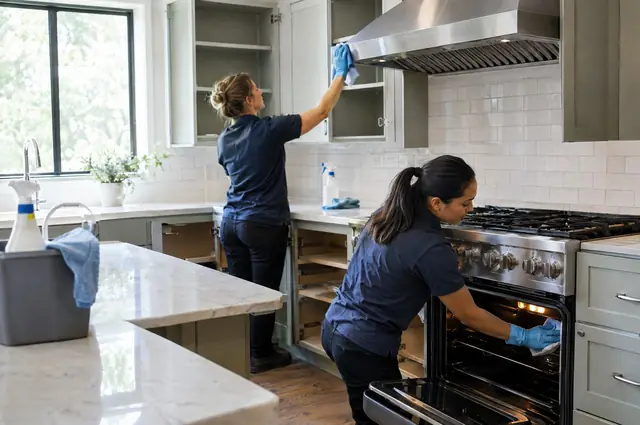
- Clean the oven interior, racks and the stovetop, including under the burners and the knobs
- Clean the microwave inside and out, plus the range hood and its filter
- Wipe cabinet fronts, handles and the tops of cabinets
- Scrub the backsplash and the caulk line where the counter meets the wall
- Clean the sink, faucet base and drain, and sanitize or replace the sponge
- Descale the coffee maker and wipe small appliances
- Pull out the stove and fridge if you can, and clean the floor and sides underneath
- Empty, wash and reline the trash can
What Goes on a Bathroom Deep Cleaning Checklist?
A bathroom deep clean removes soap scum and hard water buildup from the tub, shower and glass, cleans grout and caulk, scrubs the toilet including the base and hinges, and reaches fixtures, the exhaust fan and the floor behind the toilet. It also covers the small items people forget, like the toothbrush holder.
That holder matters. NSF's study found the toothbrush holder was the germiest spot in the bathroom, ahead of the toilet seat or handle, because it sits close to the toilet and catches what a flush sends into the air. NSF recommends running it through the dishwasher if it is safe to do so, or washing it in hot soapy water.
- Spray the tub, shower and glass first and let the cleaner sit
- Dust the exhaust fan cover, light fixtures and the top of the mirror
- Scrub tile and grout lines, and check caulk for mildew
- Clean the toilet inside and out, including the base, bolt caps and hinges
- Wash the toothbrush holder and soap dish
- Polish faucets, handles and the showerhead, and remove hard water spots
- Wipe cabinet fronts and clean inside the vanity drawers
- Clean behind the toilet and along the baseboards, then mop the floor
The spot we find most often missed in homes is the floor behind the toilet and the baseboard beside it. It does not show from the doorway, so it can go years without being touched. If grout lines have gone dark and do not come back with scrubbing, our guide on how to clean grout covers what works, or our tile and grout cleaning crew can take care of it.
What Should You Deep Clean in a Bedroom?
A bedroom deep clean focuses on the bed and the dust around it: washing all bedding, vacuuming the mattress, cleaning under the bed, dusting fans, blinds and closet shelves, and wiping baseboards. Bedrooms collect dust mites, which feed on skin flakes and live in bedding, mattresses and carpet.
National Jewish Health, a leading respiratory hospital, recommends washing all bedding weekly in hot water around 130°F, keeping indoor humidity below 40%, and vacuuming carpet and rugs often to control dust mites.
- Strip the bed and wash sheets, pillowcases, blankets and mattress pads in hot water
- Vacuum the mattress and flip or rotate it if the maker allows
- Clean under the bed and behind the nightstands
- Dust the ceiling fan, light fixtures, blinds and window sills
- Wipe dressers, headboards, lamps and closet shelves
- Wipe door frames, switch plates and baseboards
- Vacuum the floor, edges and closet floor
What Belongs on a Living Room Deep Cleaning Checklist?
Living areas need upholstery, electronics, shelves, vents and everything under the couch cushions. A deep clean here means moving furniture where you can, vacuuming sofas and chairs thoroughly, dusting every shelf and frame, and cleaning vent covers and returns so dust stops circulating back into the room.
Indoor air is part of the reason. The EPA notes that Americans spend about 90% of their time indoors, where the concentrations of some pollutants are often 2 to 5 times higher than typical outdoor levels. Dust on vents, fans and fabric adds to what you breathe at home.
- Dust ceiling fans, light fixtures, crown molding and high shelves
- Clean vent covers and air returns
- Remove cushions and vacuum sofas and chairs, including the crevices
- Dust and wipe TV stands, electronics and remotes
- Wipe picture frames, lamps and decor
- Clean switch plates, door handles and door frames
- Move furniture where possible and vacuum underneath
If the couch needs more than a vacuum, our upholstery cleaning pulls out stains and odors that surface cleaning cannot reach.
How Do You Deep Clean Floors?
Deep cleaning floors means getting the edges, corners and the areas under furniture that a weekly vacuum skips, then treating each floor type the right way. Hard floors get vacuumed and mopped, grout gets scrubbed, and carpet gets treated for traffic lanes and spots. Floors always come last in a deep clean.
- Vacuum edges and corners with a crevice tool before the open floor
- Move furniture where you can and clean underneath
- Mop hard floors with the cleaner the floor maker recommends
- Scrub grout lines on tile floors
- Spot treat carpet stains and traffic lanes
- Wash or shake out entry mats and area rugs
A vacuum lifts surface dirt, but it cannot pull out what is ground into the base of carpet fibers in traffic lanes. When those lanes stay gray after vacuuming, that is the point where hot water extraction does what a homeowner machine cannot. That is the work our carpet cleaning and area rug cleaning crews handle.
What Does Deep Cleaning Windows Involve?
Deep cleaning windows covers the glass inside and out, plus the parts that collect the real dirt: sills, tracks, frames and screens. Tracks hold dust, dead bugs and grit that make windows hard to open.
- Vacuum window tracks, then wipe them with a damp cloth
- Remove, wash and dry screens
- Clean the glass inside and out
- Wipe frames and sills
- Dust or wash blinds, and wash or vacuum curtains
Second story glass is where most people stop. Our window cleaning service handles the windows you cannot reach safely.
What Do People Forget to Deep Clean?
The most forgotten spots are the hard to reach ones: behind and under appliances and furniture, vents, the tops of cabinets and the dryer lint system. In the American Cleaning Institute's 2024 survey, 49% of Americans said cleaning hard to reach spaces was the spring cleaning task they dreaded most.
One of those spots is a safety issue. In its most recent report on the topic, covering 2008 to 2010, the U.S. Fire Administration estimated about 2,900 clothes dryer fires in residential buildings each year, and failure to clean was the leading factor behind them, at 34%. Clean the lint screen and the area around it, and have the vent line checked if your dryer takes longer than it used to.
- Dryer lint screen, the slot it sits in, and behind the dryer
- Tops of the fridge, cabinets and door frames
- Light switches, door handles and remotes
- Trash cans, inside and out
- Under sinks and inside the vanity
- Behind the toilet
- Baseboards in every room
How Long Does a Deep Clean Take?
A professional deep clean usually takes 3 to 6 hours, according to both Housecall Pro's house cleaning price guide and HomeAdvisor's 2026 cost guide, depending on the size of the home, its condition and how many cleaners are working. A move-out clean, which includes empty cabinets and appliances, runs 4 to 8 hours.
Doing it yourself takes longer: in the American Cleaning Institute survey, 45% of spring cleaners said it takes three days or more. If you are moving, our move-out cleaning checklist adds the extra steps landlords look for.
How Often Should You Deep Clean Your House?
Most homes need a full deep clean once or twice a year, with kitchens and bathrooms deep cleaned more often. Some jobs have their own schedule: National Jewish Health recommends washing bedding weekly in hot water, and CDC guidance says to clean high touch surfaces like light switches, doorknobs and countertops regularly.
| Area | Our recommendation |
|---|---|
| Bedding | Weekly, hot water (National Jewish Health) |
| Kitchen and bathrooms | Deep clean every 1 to 3 months |
| Baseboards, vents, fans and blinds | Every 3 to 6 months |
| Whole house deep clean | Once or twice a year, or before a move or a big event |
| Carpet and upholstery | Professional cleaning about once a year, more with pets or kids |
Disinfecting is a separate step. The CDC says routine cleaning is usually enough at home, and disinfecting matters most when someone in the house is sick or has a weakened immune system. When you do disinfect, clean the surface first and leave the product on for the contact time on its label.
When Should You Call a Pro for a Deep Clean?
Call a pro when the house has gone a long time without a deep clean, before you move in or out, before hosting, or when you simply do not have three days to give it. At Phillips Care Cleaning, we start with a free walk-through, give you a written checklist and quote, and send the same crew to do the work.
We have cleaned homes and businesses around Warren since 2012, we are insured and bonded, and the owner takes your call. We can deep clean once to reset the house, then keep it there with regular visits on a flat per-visit price. Call (330) 219-7916 or use the form below, and see our full house cleaning service.
Sources
- NSF International, Surprising places where germs like to hide, consumer fact sheet on the NSF household germ study (2011), retrieved 2026-10-16
- American Cleaning Institute via Newswise, ACI Survey: 80% of Americans Now Spring Clean Every Year (Wakefield Research, Mar 6, 2024), retrieved 2026-10-16
- Housecall Pro, House Cleaning Prices (updated 2026, includes Angi deep cleaning figures), retrieved 2026-10-16
- HomeAdvisor, How Much Does Professional House Cleaning Cost in 2026? (updated Jun 19, 2026), retrieved 2026-10-16
- National Jewish Health, Dust Mite Allergy, retrieved 2026-10-16
- U.S. Environmental Protection Agency, Report on the Environment: Indoor Air Quality, retrieved 2026-10-16
- U.S. Fire Administration, Clothes Dryer Fires in Residential Buildings, 2008-2010 (Topical Fire Report, Aug 2012), retrieved 2026-10-16
- CDC, When and How to Clean and Disinfect Your Home, retrieved 2026-10-16
Frequently asked questions
Deep Cleaning Checklist questions, answered.
A free walk-through is the best way to plan your cleaning. These are the questions we hear most from Valley homeowners.
What is included in a deep cleaning checklist?
A deep cleaning checklist covers the jobs a regular cleaning skips: inside the oven, fridge and microwave, cabinet fronts, baseboards, vents, ceiling fans, light fixtures, grout, window tracks, upholstery and the floor under and behind furniture and appliances. It is organized room by room and worked top to bottom, so floors are always cleaned last.
How is deep cleaning different from regular cleaning?
Regular cleaning maintains visible surfaces each week, like counters, sinks, toilets and floors. Deep cleaning goes inside, behind, under and up high to remove buildup. Housecall Pro's guide puts a standard cleaning at $140 to $220 and cites Angi's $180 to $375 range for a whole home deep clean, because it takes much more time.
How long does it take to deep clean a house?
A professional deep clean usually takes 3 to 6 hours, according to both Housecall Pro and HomeAdvisor, depending on home size, condition and crew size. Move-out cleaning runs 4 to 8 hours. Doing it alone takes longer: in an American Cleaning Institute survey, 45% of spring cleaners said the job takes three or more days.
How often should you deep clean your home?
Most homes need a whole house deep clean once or twice a year, with kitchens and bathrooms deep cleaned every one to three months. Bedding should be washed weekly in hot water, per National Jewish Health. Homes with pets, kids or allergies benefit from deep cleaning more often.
What room should you deep clean first?
Start by dusting high surfaces in every room, then deep clean the kitchen, since a 2011 NSF International household germ study found it held the most germs in the home. Do bathrooms next, then bedrooms and living areas, and finish with floors so nothing you clean later lands on a clean floor.
Is it worth hiring a professional for a deep clean?
It is worth it when the home has gone a long time without one, before a move, or when you do not have several days to spare. A crew brings the equipment for carpet, upholstery and grout and finishes in hours instead of days. Phillips Care Cleaning offers a free walk-through and a written quote.
Related services
More from the same crew
House Cleaning
Regular and deep cleaning for homes and apartments, room by room, by the same crew every visit.
Explore serviceCarpet Cleaning
Deep carpet cleaning that lifts traffic lanes, pet stains and odors from the carpet in your home.
Explore serviceTile & Grout Cleaning
Kitchen, bath and entry tile scrubbed and grout lines cleaned back to their real color.
Explore serviceRequest a free quote
One walk-through, one written price, one number to call: (330) 219-7916.
Start the conversation