
How to Clean Grout · Warren, OH
How to Clean Grout (and When to Call a Pro)
A step-by-step method that works on cement and epoxy grout, the cleaners to keep off natural stone, and how to tell when scrubbing is no longer enough.
Request a Free Walk-ThroughCall (330) 219-7916
Every home starts with a free walk-through and a written checklist and price.
Prefer to talk it through? Call (330) 219-7916, Monday to Friday, 9 to 5.
- Scope built around youA written checklist for your home, not a generic list.
- Planned service windowsNights, weekends or days, around your hours.
- Same crew every visitPeople who learn your home and its priorities.
- Local Valley routesRun from our Warren office since 2012.
To clean grout, sweep or vacuum first, apply an alkaline or pH-neutral cleaner, let it sit a few minutes, scrub the grout lines with a stiff nylon brush, then rinse and pick up the dirty water instead of letting it dry back into the joints. The Tile Council of North America calls cleaning, extracting and rinsing "the absolutely best way to clean grout." Skip vinegar and acids on cement grout and natural stone.
Grout gets dark for a simple reason. Most of it is cement, and cement is porous, so it soaks up mop water, grease and soap. Our crews scrub kitchen floors, shower walls and restroom tile across Warren and Youngstown every week, and the method below is the same order we follow, scaled down for a homeowner with a bucket and a brush. If you would rather hand it off, see our tile and grout cleaning service.
What Kind of Grout and Tile Do You Have?
Most homes have cement-based grout, which the Tile Council of North America (TCNA) describes as porous enough to absorb a stain. Epoxy grout is nearly as stain resistant as the tile itself. The tile matters just as much: ceramic and porcelain handle stronger cleaners, while marble, limestone and travertine react to any acid.
You can usually tell the grout type by feel and age. Cement grout looks sandy or matte and darkens when wet. Epoxy grout looks slightly glossy, feels almost plastic and was most likely put in on purpose by an installer, often in a newer shower or a commercial kitchen. If you are not sure, treat it as cement grout. That is the more fragile choice, so the safe method still works.
| Surface | Safe to use | Keep off it |
|---|---|---|
| Cement grout (sanded or unsanded) | Alkaline grout cleaner, pH-neutral tile cleaner, baking soda paste, oxygen bleach mixed per the label | Vinegar, lemon, acid tile cleaners, wax or oil soaps |
| Epoxy grout | pH-neutral or mild tile cleaner | Harsh chemicals used over and over, which LATICRETE says can dull the surface |
| Ceramic and porcelain tile | Alkaline or neutral cleaners, stiff nylon brushes | Wire brushes and steel wool, which scratch glaze and leave rust marks |
| Natural stone (marble, limestone, travertine) | Neutral cleaner, stone soap or mild dish soap and warm water | Vinegar, lemon, acid cleaners, scouring powder, rust removers |
The Natural Stone Institute is direct about the stone row: "Products containing lemon, vinegar or other acids may dull or etch calcareous stones," and scouring powders "may scratch certain stones." It also warns that some rust removers contain hydrofluoric acid, which attacks every type of stone, granite included.
What Is the Best Thing to Clean Grout With?
The best grout cleaner for most homes is an alkaline tile and grout cleaner or a pH-neutral cleaner, used with a stiff nylon brush. TCNA says alkaline cleaners are preferred over acids, because acids dissolve the cement in grout. For light dirt, a paste of baking soda and water is a gentle, cheap alternative on ceramic and porcelain.
Grout sealer makers say the same thing about upkeep. LATICRETE's data sheet for its STONETECH Heavy Duty Grout Sealer says highly alkaline, acidic, ammoniated or abrasive cleaners are not needed for daily maintenance and can wear down the sealer. It recommends a neutral pH cleaner for routine cleaning and a stronger cleaner with a nylon pad or stiff brush only for tough soil.
Avoid oil soaps and wax-based floor cleaners on tile. TCNA notes they leave a film that attracts dirt, and soap left on the floor does the same. That film is why a floor can look fine wet and gray again two days later.
Here is what we see on almost every first visit: the grout is not dirty because nobody cleans it. It is dirty because it gets mopped often with a cleaner that never gets rinsed. Each mopping leaves a thin layer of soap and dirty water in the joints. Using less product and rinsing with clean water fixes more grout than any stronger chemical does.
How to Clean Grout, Step by Step
This is the method TCNA calls the best way to clean grout, adapted for a home without a truck-mounted extractor. Plan on about 30 to 60 minutes for a small bathroom floor. Work in sections of about 3 by 3 feet so the cleaner never dries on the floor before you rinse it.
- Remove loose dirt. Sweep and vacuum the floor, including the edges. Grit left on the floor turns to mud the moment it gets wet and packs into the grout lines.
- Test a small spot. Try your cleaner in a corner or behind the toilet first, especially on colored grout or any stone tile. Check for fading or dull spots after it dries.
- Apply the cleaner. Spray or brush the cleaner onto the grout lines, mixed exactly as the label says. Let it sit for the dwell time on the label, usually a few minutes. Do not let it dry.
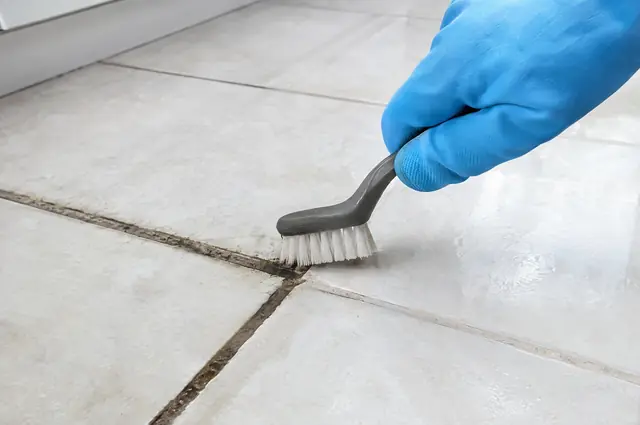
- Scrub the joints. Use a stiff nylon grout brush along each line, then across it. A narrow brush gets into the joint better than a sponge. Never use a wire brush on glazed tile.
- Pick up the dirty water. This is the step most people skip. Use a wet/dry vacuum, a squeegee and towels, or a sponge you wring out into a separate bucket. The goal is to get the dirt off the floor, not spread it.
- Rinse with clean water. Wipe or mop with plain water and pick it up again. TCNA says leftover soap film is one of the most common reasons grout gets dirty again fast.
- Dry and check. Let the floor dry fully, then look at it in daylight. Spots that are still dark may need a second pass or a stronger alkaline cleaner.
Here is a quick supply list for the job:
- Stiff nylon grout brush (not wire)
- Alkaline or pH-neutral tile and grout cleaner
- Baking soda for a paste on light stains
- Two buckets: one for cleaner, one for wringing dirty water
- Wet/dry vacuum or squeegee and old towels
- Rubber gloves and eye protection
- A fan or open window for ventilation
Can You Clean Grout With Vinegar or Bleach?
Vinegar is a poor choice for grout. It is an acid, and TCNA says acids dissolve the cement in grout and can strip some of its color, while the Natural Stone Institute says vinegar can etch marble, limestone and travertine. Bleach can lighten mildew stains on ceramic tile, but it should only ever be used alone, rinsed well and with fresh air.
The bigger danger is mixing. In its "Mixing Bleach with Other Cleaning Products Can Be Deadly" hazard alert, the New Jersey Department of Health explains that bleach mixed with ammonia creates chloramine gases, and bleach mixed with an acid releases chlorine gas. Even low levels can cause coughing and breathing problems, and very high levels can be fatal.
The same alert lists vinegar, lemon juice, toilet bowl cleaners, rust removers and some drain cleaners as products that react with bleach. It also warns that hydrogen peroxide mixed with vinegar forms peracetic acid, which irritates eyes, skin and lungs. That rules out a lot of the "magic grout paste" recipes passed around online.
The risky moment is not usually mixing two bottles on purpose. It is spraying bleach on shower grout that still has an acid soap scum remover or toilet cleaner on it from earlier in the day. Our rule on every job is one product per surface, rinse it off completely, then move to the next one. Do the same at home and you avoid the problem entirely.
How Do You Get Mold Out of Shower Grout?
For mold on tile and grout, the EPA says to "scrub mold off hard surfaces with detergent and water, and dry completely." If the moldy area is smaller than about 10 square feet, the EPA says you can usually handle it yourself. Running a fan or opening a window and cleaning more often helps keep it from coming back.
Shower grout is the hardest grout in the house to keep clean because it is wet every day. The EPA notes that places that are often or always damp can be hard to keep completely free of mold. Squeegee the walls after showers, run the exhaust fan for a while afterward and wash the grout on a regular schedule. If dark spots come back within days of a good scrub, the mold may be growing behind cracked grout or failed caulk, which cleaning cannot reach.
Should You Seal Grout, and How Often?
Yes, seal cement grout after a deep clean. TCNA calls sealing a very good idea for cement grout and says epoxy grout does not need it. LATICRETE rates its STONETECH grout sealers for up to 5 years of wear on indoor surfaces and up to 3 years outdoors, and recommends reapplying its Stone, Tile and Grout Sealer annually for best results.
Timing matters. Grout has to be clean and fully dry before sealer goes on, or you seal the dirt in. For brand new grout, Custom Building Products' TileLab Grout Sealer data sheet says to let the grout cure 48 to 72 hours, and LATICRETE's sealer sheets say to wait at least 72 hours. TCNA adds that penetrating sealers last longer than topical ones, which wear off under foot traffic.
| Area | How often to recheck the seal | Why |
|---|---|---|
| Showers and tub surrounds | Every 6 to 12 months | Daily water and soap wear sealer fastest |
| Kitchen and entry floors | Once a year | Grease, spills, salt and foot traffic |
| Bathroom floors and backsplashes | Every 1 to 2 years | Less water and wear than a shower |
| Epoxy grout | No sealing needed | Non-porous, per TCNA and LATICRETE |
Those intervals are our working schedule, not a manufacturer rule. The easy way to check is a water drop test. Put a few drops of water on the grout. If they bead up, the sealer is still working. If the grout darkens and soaks them in within a minute or two, it is time to clean and reseal.
When Should You Call a Pro to Clean or Regrout?
Call a pro when the grout is still dark after two careful cleanings, when you have a large area or a natural stone floor, or when the grout is cracked, crumbling or missing. Cleaning fixes dirt. It cannot fix grout that has failed, and TCNA says joints "cannot be grouted over" successfully.
- Grout stays gray, brown or black after two full cleanings
- Cracks, crumbling or gaps along grout lines
- Loose or hollow-sounding tiles near the bad grout
- Mold that returns within days of scrubbing
- Etched or dull spots on marble or travertine from old acid cleaners
- A whole kitchen, basement or commercial restroom to do, not one small bathroom
Cracked or crumbling grout usually means regrouting, and that is a bigger job. TCNA says at least two thirds of the old grout's depth has to come out before new grout goes in, and that cracking often traces back to movement in the floor below. HomeAdvisor's 2026 cost guide puts regrouting at $10 to $25 per square foot, with an average shower regrout around $1,500. That is why it pays to clean and seal before grout gets that far.
A tip from the field: before you assume grout is ruined, look at the grout behind the toilet or under the edge of a rug. Those spots get less traffic and mopping. If that grout is lighter, the rest is just dirty and will clean up. If it is the same dark color everywhere, the grout may have been stained or colored that way, and a pro can tell you which before you spend money on regrouting.
How Phillips Care Cleans Tile and Grout
Our crews follow the same order you just read, with commercial tools. We identify the tile, test a spot, pre-treat, scrub the grout lines by hand and by machine, then rinse with hot water and extract so the dirt leaves the building. Sealing is available at the end of the same visit. Stone gets stone-safe products only.
We clean tile in kitchens, showers, entries and commercial restrooms across Trumbull and Mahoning County, and tile and grout work pairs well with house cleaning or a full move-out cleaning, where clean grout helps a rental pass inspection. Working through the whole house? Our deep cleaning checklist covers every room, and our guide to carpet cleaning cost in Warren explains pricing for the carpeted rooms. Fernando Phillips founded the company in Warren in 2012, and we are insured and bonded. Call (330) 219-7916 or book a free walk-through on our tile and grout cleaning page.
Sources
- Tile Council of North America, FAQ: Cleaning Grout, retrieved 2026-10-16
- Tile Council of North America, FAQ: Cracked/Loose Grout, retrieved 2026-10-16
- New Jersey Department of Health, Hazard Alert: Mixing Bleach with Other Cleaning Products Can Be Deadly, retrieved 2026-10-16
- Natural Stone Institute, Care and Cleaning for Natural Stone Surfaces, retrieved 2026-10-16
- U.S. EPA, Mold Cleanup in Your Home, retrieved 2026-10-16
- LATICRETE, Everything You Need to Know About Epoxy Grout (Jun 27, 2025), retrieved 2026-10-16
- LATICRETE, STONETECH Heavy Duty Grout Sealer, Data Sheet 203, retrieved 2026-10-16
- LATICRETE, STONETECH Stone, Tile and Grout Sealer, Data Sheet 224, retrieved 2026-10-16
- Custom Building Products, TileLab Grout Sealer, TDS-147 (Sep 13, 2021), retrieved 2026-10-16
- HomeAdvisor, How Much Does It Cost to Regrout a Shower in 2026? (updated Jun 20, 2026), retrieved 2026-10-16
Frequently asked questions
How to Clean Grout questions, answered.
A free walk-through is the best way to plan your cleaning. These are the questions we hear most from Valley homeowners.
What is the best homemade grout cleaner?
For light dirt on ceramic or porcelain tile, a paste of baking soda and water scrubbed in with a stiff nylon brush works well and is gentle on grout. Rinse it off completely afterward. Skip recipes with vinegar, because the Tile Council of North America says acids dissolve cement grout, and the New Jersey Department of Health warns that hydrogen peroxide mixed with vinegar forms peracetic acid, which irritates eyes, skin and lungs.
Will Dawn and vinegar clean grout?
Dish soap alone is fine for light cleaning if you rinse it well, since leftover soap film attracts dirt. Adding vinegar is the problem. Vinegar is an acid, and the Tile Council of North America says acids dissolve the cement in grout. The Natural Stone Institute also warns vinegar can dull or etch marble, limestone and travertine. A pH-neutral or alkaline tile cleaner is a safer choice.
How do you get grout white again?
Start with a deep clean: an alkaline grout cleaner, a stiff brush, then extract and rinse the dirty water so it does not dry back into the joints. Two careful passes bring most grout close to its original color. If it is still dark, the stain may be deep in the cement, and TCNA lists pressurized steam as the next step before cutting out and regrouting. Seal it once it is clean and dry.
How often should grout be cleaned?
Wipe or mop tile weekly with a neutral cleaner and clean water, and scrub the grout lines whenever they start to darken, often every month or two in showers and kitchens. A professional deep clean once or twice a year keeps heavy use areas in shape. Sealing cement grout after a deep clean slows how fast dirt and water soak back in, so it stays clean longer.
Can you use bleach on grout?
You can use diluted chlorine bleach on mildew stains on ceramic or porcelain tile grout, but only by itself, with good ventilation, and rinsed off completely. Never use it with ammonia, vinegar, toilet bowl cleaners or other acids. The New Jersey Department of Health warns those mixes release chloramine or chlorine gas. Keep bleach off colored grout and natural stone, where it can fade or damage the surface.
Is it better to clean grout or regrout?
Clean first. Most dark grout is dirty, not failed, and a deep clean costs far less than regrouting. Regrout when grout is cracked, crumbling or missing. TCNA says joints cannot be grouted over and at least two thirds of the old grout depth must be removed. HomeAdvisor's 2026 guide puts regrouting at $10 to $25 per square foot, so cleaning and sealing on schedule is the cheaper path.
Related services
More from the same crew
Tile & Grout Cleaning
Kitchen, bath and entry tile scrubbed and grout lines cleaned back to their real color.
Explore serviceHouse Cleaning
Regular and deep cleaning for homes and apartments, room by room, by the same crew every visit.
Explore serviceMove-Out Cleaning
Move-in, move-out and rental turnover cleaning that gets the deposit back and the unit ready to rent.
Explore serviceRequest a free quote
One walk-through, one written price, one number to call: (330) 219-7916.
Start the conversation