
How Often to Pressure Wash · Warren, OH
How Often Should You Pressure Wash Your House?
A surface by surface schedule for siding, brick, decks and driveways, when to soft wash instead, and what Northeast Ohio weather does to the plan.
Request a Free Walk-ThroughCall (330) 219-7916
Every home starts with a free walk-through and a written checklist and price.
Prefer to talk it through? Call (330) 219-7916, Monday to Friday, 9 to 5.
- Scope built around youA written checklist for your home, not a generic list.
- Planned service windowsNights, weekends or days, around your hours.
- Same crew every visitPeople who learn your home and its priorities.
- Local Valley routesRun from our Warren office since 2012.
Most houses should be washed once a year, usually in spring. Shady walls that grow green algae, homes under trees and houses on busy roads may need it twice a year. Siding, brick and wood all take low pressure or a soft wash. Concrete driveways and walks can take full pressure, and in Ohio they benefit most from a cleaning right after winter salt season.
We pressure wash houses, driveways, decks and storefronts across Warren, Youngstown and the rest of Trumbull and Mahoning County. The question we hear most is how often it actually needs to be done. Below is what the siding, brick, decking and concrete industries publish, a simple schedule by surface, and how our crews handle it. If you already know it's time, see our pressure washing page.
How Often Should You Pressure Wash Your House?
Once a year is the right starting point for most homes. James Hardie, a major fiber cement siding maker, tells homeowners to use a low pressure spray from a garden hose and a soft, medium bristle brush to remove dirt and debris once or twice a year. Vinyl siding is lower maintenance but still needs periodic cleaning.
Move to twice a year if any of these describe your house: a north wall that stays shady and turns green, big trees that drop pollen and sap, a gravel or dirt road nearby, or a spot near a busy street where road grime sprays up. Houses that sit in full sun on an open lot can often go longer between full washes, with a hose rinse in between.
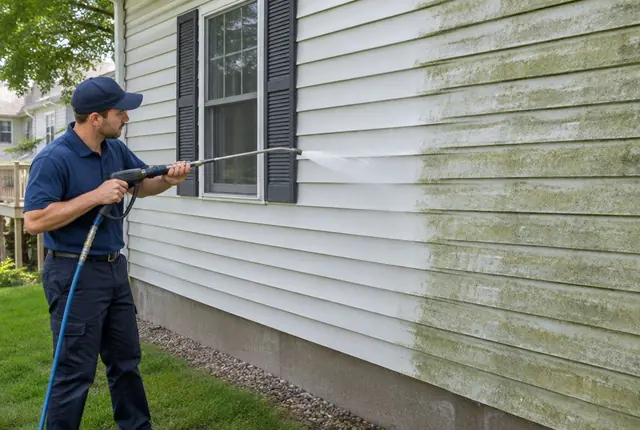
The quick test we give homeowners: walk around the house on a cloudy day and look at the bottom two feet of siding and the side that gets the least sun. If you see a green or gray film there, or black streaks running down from the gutters, the house is due. Those two spots go first on almost every house in the Valley, usually a full season before the front of the house looks dirty.
How Often to Wash Each Surface
Every surface on a property wears differently and takes a different pressure. This table pulls the published limits together with the schedule we recommend for Northeast Ohio homes. The pressure limits come from the manufacturers and trade groups named. The frequency column is our recommendation unless a source is named.
| Surface | How often | Pressure guidance |
|---|---|---|
| Vinyl siding | Once a year; shady walls twice | Low pressure, wand at eye level, never aimed up (siding trade group, formerly VSI) |
| Fiber cement siding | Once or twice a year (James Hardie) | Garden hose and soft brush; Hardie says a pressure washer can damage the surface |
| Brick | Every 1 to 3 years, or when stained | 400 psi max at the nozzle unless the brick maker allows more (Brick Industry Association) |
| Wood deck | Once a year, before staining or sealing | 800 psi max, fan tip 30 degrees or wider, 8 inches or more away (Viance) |
| Composite deck | Spring and fall (Trex) | 3,100 psi max with a fan tip, 8 inches or more away, newer Trex lines only (Trex) |
| Concrete driveway and walks | Once a year in spring | Full pressure with a surface cleaner is fine on cured concrete |
| Asphalt shingle roof | Only when streaks appear | No pressure washer at all (Asphalt Roofing Manufacturers Association) |
How Often Should You Wash Vinyl Siding?
Wash vinyl siding once a year, and the shady side twice if algae comes back fast. The Polymeric Exterior Products Association, the siding trade group formerly known as the Vinyl Siding Institute, says vinyl only requires periodic cleaning with mild soap and water from a garden hose, and that a simple rinse is often enough for routine cleaning.
The same group says a power washer can be used on vinyl, but with caution. Its guidance is to read the instructions for both the siding and the washer first, hold the washer straight at eye level, and never aim the stream upward, because that can force water behind the siding panels. It also notes that some siding makers do not recommend power washing at all, while others limit the pressure and the cleaners you can use. So check your siding warranty before anyone puts a wand on it.
For mildew, the group suggests a solution of 30% vinegar and 70% water for larger areas. It also lists products to keep off vinyl entirely, including cleaners with organic solvents, undiluted chlorine bleach, liquid grease remover, nail polish remover and furniture polish.
Can You Pressure Wash Brick?
Yes, at low pressure and with the right tip. The Brick Industry Association's Technical Note 20 (August 2018) says not to use water pressure higher than 400 psi measured at the nozzle unless the brick maker permits it. It calls for a 25 to 50 degree stainless steel fan tip held at least 12 inches from the brick, and says anything over 800 psi is not appropriate for brick.
The reason is the mortar. The BIA note warns that too much pressure can damage brick surfaces, erode mortar joints and remove finishes or coatings, which changes how the wall looks. Every 1 to 3 years is plenty for most homes, sooner if you see green growth on a shady wall or white efflorescence after a wet spring.
How Often Should You Clean a Wood or Composite Deck?
Clean a wood deck once a year, ideally right before you stain or seal it. Composite decks do best with two cleanings. Trex says semi-annual cleaning in spring and fall is important for composite decking because it keeps pollen and debris from building up and feeding mold.
Pressure is where decks get ruined. Viance, which makes the preservatives used in pressure treated lumber, says to use no more than 800 psi on a treated wood deck, a fan tip of at least 30 degrees, and to keep the tip at least 8 inches from the boards, because you can damage the wood fibers or even scar the wood. Trex allows up to 3,100 psi with a fan tip on its newer high performance lines, but says going over that could damage the boards and void the warranty.
A wood deck that looks fuzzy after a wash was hit too hard. Those raised fibers are the top layer of the board torn loose, and they soak up stain unevenly and gray out faster. On wood we use low pressure, let a cleaning solution do the work, and keep the wand moving with the grain from one end of the board to the other. Stopping mid-board is what leaves the stripes you can see from the yard.
How Often Should You Pressure Wash a Concrete Driveway?
Once a year in spring is enough for most driveways. Concrete is the one surface around a house that can take full pressure. A rotating surface cleaner gives an even finish without the stripes a bare wand leaves. The bigger risk to an Ohio driveway is winter salt, not dirt.
The Pennsylvania Aggregates and Concrete Association, writing about the Northeast's cold climate, says homeowners often find scaling and pock marks on driveways each spring after the snow melts. It recommends no deicers in the first year of a driveway's life, warns never to use ammonium sulfate or ammonium nitrate as a deicer, and notes that a sealer keeps chloride-laden moisture from soaking into the slab. A spring wash gets the salt film off, and it's the step to do before sealing a driveway.
Pressure Washing vs Soft Washing: Which Does Your House Need?
Pressure washing uses a high pressure stream of water to blast dirt off hard surfaces like concrete. Soft washing uses low pressure plus a cleaning solution that kills algae and mildew, then rinses it away gently. Most houses need both: soft washing for siding, trim and wood, and pressure washing for driveways, walks and patios.
Roofs are the clearest example of why the difference matters. The Asphalt Roofing Manufacturers Association says not to use a power washer or any type of brush or broom to clean algae from a roof. Its guidance is a chemical solution left on for at least 15 minutes but no more than 20, followed by a gentle rinse. The black streaks themselves are usually an algae called Gloeocapsa magma, which ARMA says travels through the air and slowly darkens light colored roofs. The same algae and mildew grow on siding, and a soft wash treats the growth instead of just knocking the top layer off.
| Pressure washing | Soft washing | |
|---|---|---|
| How it cleans | Force of the water | Cleaning solution, then a gentle rinse |
| Best for | Concrete driveways, sidewalks, patios, curbs | Vinyl and painted siding, trim, soffits, wood |
| Risk if misused | Water behind siding, torn wood fibers, eroded mortar | Runoff on plants if they aren't wet down and covered |
| How long it stays clean | Until dirt tracks back in | Longer on siding, because the algae is killed, not just rinsed |
When Is the Best Time to Pressure Wash in Ohio?
Spring is the best time for most homes in Northeast Ohio, once nights stay above freezing. A spring wash clears winter salt from walks and driveways, plus the mud splash and pollen on the siding. Fall is the second best time, for a last wash before winter so algae and grime don't sit on the house all winter.
Summer works too, and it's when algae grows fastest on shady walls and decks. The one season to skip is winter. Water left on concrete, steps and decks turns to ice, and water that gets into cracks freezes and widens them. If you're also staining a deck, plan the wash a few dry days ahead so the wood has time to dry out first.
What Damages Siding During a Wash
Most siding damage from washing comes from a handful of mistakes, all covered in the manufacturer guidance above.
- Aiming the wand upward on lap siding, which drives water behind the panels (siding trade group, formerly VSI)
- Using too narrow a tip or holding it too close, which gouges wood and etches soft surfaces
- Spraying hard around windows, doors, vents, outlets and light fixtures, which the siding trade group says many makers caution against
- Using undiluted chlorine bleach or solvent cleaners on vinyl
- Pressure washing fiber cement, which James Hardie says can damage the surface
- Blasting brick above 400 psi, which can erode the mortar joints (Brick Industry Association)
- Washing loose or flaking old paint, which can come off in chips and may contain lead
The damage people don't notice until later is water inside the wall. A crew that sprays upward under the bottom lip of vinyl siding can push water into the wall cavity, and it can take weeks to show up as a musty smell or a stain on an inside wall. That's why our crews keep the spray level or angled down on siding, and why we wet down and cover plants before any cleaning solution goes on.
Pressure Washer Safety
A pressure washer is a serious tool. Consumer Reports, citing 2014 Consumer Product Safety Commission data, reported that an estimated 6,057 people went to the emergency room with pressure washer injuries that year, and 14% of those visits led to additional hospitalization. Lacerations were the most common injury, followed by bruises, punctures and eye injuries.
Consumer Reports also stopped recommending pressure washers that come with nozzles narrower than 15 degrees, and advises owners of zero degree (red) nozzles to get rid of them. If you wash your own house, follow these rules.
- Wear eye protection and closed toe shoes, and keep kids and pets inside
- Never point the wand at a person, a pet or your own feet
- Start with the widest fan tip and step down only if you need to
- Don't run a pressure washer from a ladder; the kickback can throw you off balance
- Keep the spray away from outlets, fixtures, meters and overhead wires
- Close windows and doors and cover plants before you start
How Phillips Care Does It
Phillips Care Cleaning has been cleaning homes and businesses around Warren since 2012. On a house wash, our crew checks each surface first, sets the pressure and tip for it, soft washes siding, trim and wood, and uses full pressure only on concrete. We cover plants and outlets, close windows and doors, and walk the property with you before we leave.
The best order for the outside of a home is gutters first, then the house wash, then windows. Clearing the gutters first keeps sludge from washing down onto clean siding, and window cleaning last means no runoff streaks the glass. Our guide to how often gutters should be cleaned covers that schedule. Planning work inside too? See our guide to house cleaning cost in Warren, Ohio.
We start with a free walk-through and a written quote, and the owner takes the call. We're insured and bonded and serve Trumbull and Mahoning County. See our pressure washing page or call (330) 219-7916 to get on the spring or fall schedule.
Sources
- Polymeric Exterior Products Association (formerly the Vinyl Siding Institute), How to Clean Vinyl Siding: Vinyl Siding Cleaning Tips, retrieved 2026-10-16
- James Hardie, Fiber Cement Siding Maintenance, retrieved 2026-10-16
- Brick Industry Association, Technical Note 20: Cleaning Brickwork (Aug 2018), retrieved 2026-10-16
- Viance (TreatedWood.com), Is Pressure Washing Bad for My Deck?, retrieved 2026-10-16
- Trex, How to Clean a Trex Deck, retrieved 2026-10-16
- Pennsylvania Aggregates and Concrete Association, Scaling (2009), retrieved 2026-10-16
- Asphalt Roofing Manufacturers Association, Algae Discoloration, retrieved 2026-10-16
- Consumer Reports, Safety Alert: Under Pressure (updated Mar 2016), retrieved 2026-10-16
Frequently asked questions
How Often to Pressure Wash questions, answered.
A free walk-through is the best way to plan your cleaning. These are the questions we hear most from Valley homeowners.
How often should you pressure wash your house?
Most houses should be washed once a year, usually in spring. Shady walls with green algae, homes under trees and houses near busy roads may need it twice a year. James Hardie tells fiber cement owners to clean once or twice a year with a garden hose and soft brush. Siding and wood should get low pressure or a soft wash, while concrete driveways can take full pressure.
Is it bad to pressure wash your house?
Not when it's done at the right pressure. High pressure on vinyl siding can force water behind the panels, especially if the wand is aimed upward, which the siding trade group (formerly the Vinyl Siding Institute) warns against. James Hardie says a pressure washer can damage fiber cement. A low pressure soft wash cleans siding safely and kills the algae instead of just rinsing it.
What is the difference between pressure washing and soft washing?
Pressure washing uses the force of a high pressure water stream to clean hard surfaces like concrete driveways and sidewalks. Soft washing uses low pressure and a cleaning solution that kills algae and mildew, then rinses it off gently. Soft washing is the right method for siding, trim, soffits and wood. Most houses need both methods for different surfaces in the same visit.
What month is best to pressure wash a house in Ohio?
In Northeast Ohio, April and May are usually best, once nights stay above freezing. A spring wash clears winter salt, mud and pollen. Early fall is the second best time, for a last cleaning before winter. Skip winter, because water left on concrete, steps and decks freezes and can widen cracks. Summer works too, and that's when algae grows fastest on shady walls.
What psi is safe for brick and wood decks?
The Brick Industry Association says not to exceed 400 psi at the nozzle on brick unless the brick maker allows more, with a 25 to 50 degree fan tip held at least 12 inches away. For treated wood decks, Viance recommends no more than 800 psi, a fan tip of at least 30 degrees and at least 8 inches between the tip and the boards.
Should you pressure wash a roof?
No. The Asphalt Roofing Manufacturers Association says not to use a power washer or any brush or broom to clean algae from asphalt shingles, because high pressure damages the roofing. Its guidance is a cleaning solution left on for 15 to 20 minutes, then a gentle rinse. The black streaks are usually an airborne algae called Gloeocapsa magma, not dirt.
Related services
More from the same crew
Pressure Washing
Driveways, sidewalks, siding and storefronts washed clean of dirt, mildew and grime.
Explore serviceGutter Cleaning
Gutters and downspouts cleared by hand and flushed, so water goes where it should.
Explore serviceWindow Cleaning
Streak-free windows, frames and sills, inside and out, for storefronts and homes.
Explore serviceRequest a free quote
One walk-through, one written price, one number to call: (330) 219-7916.
Start the conversation