
Pet Urine in Carpet · Warren, OH
How to Get Pet Urine Out of Carpet (and the Smell)
Step-by-step methods for fresh and old accidents, what never to put on urine, how to find the spots you missed, and when the padding is the real problem.
Request a Free Walk-ThroughCall (330) 219-7916
Every home starts with a free walk-through and a written checklist and price.
Prefer to talk it through? Call (330) 219-7916, Monday to Friday, 9 to 5.
- Scope built around youA written checklist for your home, not a generic list.
- Planned service windowsNights, weekends or days, around your hours.
- Same crew every visitPeople who learn your home and its priorities.
- Local Valley routesRun from our Warren office since 2012.
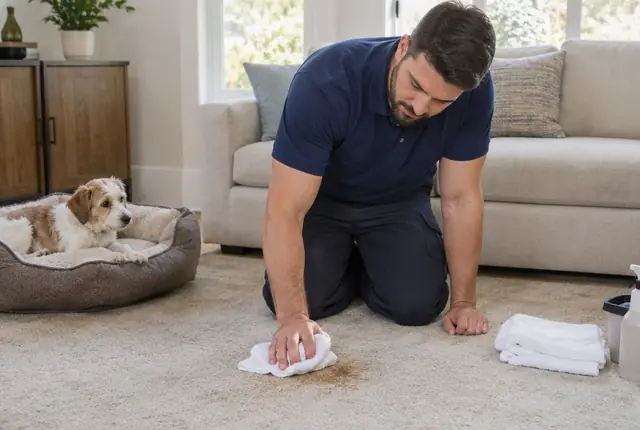
To get pet urine out of carpet, blot up as much as you can with paper towels, rinse the spot with clean cool water, pull that water back out with a wet vac or more towels, then soak the area with an enzymatic pet cleaner and let it air dry. Do not use a steam cleaner, ammonia or a heavy perfume spray. Old stains need the same steps plus more time, and urine in the pad may mean replacing that section.
Pet accidents are some of the most common calls we get for carpet cleaning in Warren and Youngstown homes. Most of those calls come after someone already tried a spray, a rented machine and a candle, and the smell came back on the first humid day. Below is the method that works, in the order that matters, plus the mistakes that make urine harder to get out.
Why Does Pet Urine Smell Come Back?
Urine soaks past the carpet fibers into the backing and pad, where surface cleaning never reaches. The Carpet and Rug Institute's technical bulletin on pet urine (revised July 27, 2017) says products that only mask the odor fail, and "in times of high humidity, the odor may reappear." Cat urine is the hardest: unless it is fully removed, complete odor removal is unlikely.
Urine also changes over the pet's life. The same CRI bulletin says its makeup shifts with diet, medications, age, health and sex, which is why one accident lifts out easily and another leaves a ring. Some spots show up right away. Others take weeks or months to react with the carpet dyes.
A pattern we see in Valley homes: the smell seems gone in January and is back in July. Dry winter air hides it, then summer humidity brings it out. If you only smell it in warm, damp weather, the urine is still in the carpet or pad, not just in the air.
How Do You Clean Fresh Pet Urine Out of Carpet?
Act while it is wet. The Humane Society of Sonoma County says the more fresh urine you remove before it dries, the simpler it is to remove the odor. Blot, rinse with cool water, extract the rinse water, then use an enzymatic cleaner from a pet supply store, testing a hidden spot first. Never rub.
- Blot, don't rub. Lay a thick layer of paper towels over the spot, cover it with newspaper and stand on it for about a minute. Repeat until the area is barely damp.
- Work from the outside in. Shaw Floors' care guide says to blot from the outer edge toward the center so the spill doesn't spread, and warns rubbing can leave a fuzzy area.
- Rinse with clean, cool water. Hot water and heat can set the stain.
- Pull the water back out. Use a wet vac, shop vac or small extractor, or blot again with fresh towels.
- Apply an enzymatic cleaner. Use enough to reach as deep as the urine went, and follow the label's wait time.
- Let it air dry. Cover with a half-inch layer of paper towels weighted with a flat, heavy object that won't transfer color, changing towels until dry (CRI).
No enzyme cleaner in the house? The CRI's own spot method uses 1/4 teaspoon of clear liquid dishwashing detergent (no bleach, no lanolin) in one cup of lukewarm water, blotted on, rinsed and repeated as long as the stain keeps transferring to the towel. The bulletin says not to use laundry detergent or automatic dishwasher detergent, and not to over-wet the carpet.
How Do You Get Old, Dried Pet Urine Out of Carpet?
Rewet the spot, then treat it like a fresh accident with more patience. The Anti-Cruelty Society suggests renting a carpet cleaner for set-in stains, following with a pet odor neutralizer and then a carpet stain remover. If any cleaner or steamer was used on the spot before, clean it first with an oxidizing pet cleaner, then apply the enzyme.
That second point trips up a lot of people. The Humane Society of Sonoma County explains that leftover residue from earlier cleaners weakens an enzymatic cleaner, which "will use up its 'energy' on the old cleaners instead of on the protein stains you want removed." An oxidizing cleaner breaks up that residue so the enzyme can do its job.
Be realistic about color. The CRI bulletin says that when urine sits for a long time, the dyes and fibers may be permanently damaged. In beige carpet, urine attacks the blue dye and leaves the red and yellow behind, so old spots turn red, yellow or orange. Cleaning can remove the urine and the smell and still leave that color change.
When we walk into a home with old pet spots, we look for the yellow and orange rings before we treat anything. Those rings tell us how long the urine has been there and whether the goal is "odor gone" or "odor gone and color back." Setting that expectation up front saves everyone a disappointing afternoon.
Do Enzyme Cleaners Really Work on Pet Urine?
Yes, when they reach all of the urine and get enough time. The Anti-Cruelty Society says enzymatic cleaners "work well in neutralizing pet odors because they are able to break down pet-waste odors." The CRI notes enzyme treatments are sold at pet stores, vet offices and retailers. They fail most often when they only wet the surface or dry too fast.
| Enzyme cleaner mistake | What happens | Fix |
|---|---|---|
| Spraying a light mist on top | Enzyme never reaches urine in the backing or pad | Use as much as the pet left, so it soaks as deep as the urine did |
| Using it over old cleaner residue | Enzyme works on the residue instead of the urine | Rinse first, or use an oxidizing pet cleaner before the enzyme |
| Blotting it right back up | Not enough time to break down the odor | Follow the label's wait time, then let it air dry |
| Following it with a steam machine | Heat sets what is left of the stain and odor | Rinse with cool water and extract instead |
What Not to Use on Pet Urine
The wrong product can set the stain, keep the smell or bring the pet back to the same spot. These are the ones pet and carpet groups warn about.
| Avoid | Why | Source |
|---|---|---|
| Steam cleaners | The heat sets the odor and stain by bonding the proteins into man-made fibers | Humane Society of Sonoma County |
| Ammonia cleaners | Smell like urine to a pet and can be irritating | Cornell Feline Health Center |
| Vinegar as the main cleaner | Strong scent can encourage the pet to go there again | Cornell; Anti-Cruelty Society |
| Bleach mixed with ammonia or acids | Creates chloramine or chlorine gas | New Jersey Department of Health |
| Laundry or dishwasher detergent | Not safe for carpet spot cleaning | Carpet and Rug Institute |
| Scented sprays and powders alone | Mask the odor, which can return in humid weather | Carpet and Rug Institute |
One note on vinegar: the CRI method does use a weak vinegar rinse (one cup of white vinegar to two cups of water) after the detergent step. That is a final rinse, not the cleaner. If your pet keeps going back to the same spot, finish with plain water and an enzyme cleaner instead, and never mix bleach with anything on the same spot.
Behavior matters too. The Cornell Feline Health Center calls house soiling "the most common behavior problem reported by cat owners" and points to medical causes, including kidney and thyroid disease and diabetes. If accidents are new or frequent, a vet visit belongs on the list next to the cleaning.
How Do You Find Hidden Urine Spots With a UV Light?
Turn off every light in the room after dark and sweep a black light (UV flashlight) slowly over the carpet, baseboards and furniture skirts. The Humane Society of Sonoma County says a black light will usually show even old urine stains because urine contains fluorescent molecules that glow. Outline each spot with chalk, then treat them all.
- Check along walls, corners, behind doors and under furniture edges first
- Look at the side of couches and chairs, not just the floor
- Mark every glowing spot with chalk before you start cleaning
- Scan again after the carpet is fully dry to confirm the spot no longer glows
The light is also your test. After cleaning and drying, a spot that no longer glows but still looks stained is a dye or color problem, which a carpet stain remover may help. A spot that still glows needs another round of rinse, extract and enzyme.
When Urine Reaches the Padding and Subfloor
If you press on the spot and it feels damp underneath, or the smell is strongest with your nose at the floor, the pad is involved. Both the Humane Society of Sonoma County and the Anti-Cruelty Society say you may need to remove and replace that portion of carpet and padding.
Long-term accidents can also loosen the carpet itself. The CRI bulletin warns that moisture can weaken the bond between carpet layers, causing delamination of the backing, and that seams are especially vulnerable. On wood subfloors and baseboards, the Humane Society of Sonoma County says discoloration means the urine's acid has affected the varnish or paint, which may need to be stripped and replaced.
The spots that come back after a professional cleaning are almost always this kind: a dog or cat that used the same corner for months. Topical cleaning cannot reach a soaked pad, so for those corners we tell you that at the walk-through instead of promising a smell-free room.
What Does Professional Pet Odor Removal Cost?
Fixr's cost guide (updated January 31, 2025) puts professional pet odor removal at $500 to $800, with a national average of $650. It lists mild problems at $100 to $250, moderate at $300 to $625 and severe at $700 to $1,250. Subfloor replacement, when urine has ruined the wood, runs $600 to $2,400 in the same guide.
| Severity (Fixr, updated Jan 2025) | Typical cost |
|---|---|
| Mild: homes with one or two fully trained animals | $100 to $250 |
| Moderate: multiple urine stains and a heavier smell of pets | $300 to $625 |
| Severe: noticeable the minute you walk into your home | $700 to $1,250 |
| Subfloor replacement | $600 to $2,400 |
Those are national figures. For what whole-room cleaning runs locally, see our guide to carpet cleaning cost in Warren, Ohio. Homes with pets also need cleaning more often than the usual schedule, which we cover in how often carpet should be cleaned.
When to Call a Pro
Call a professional when the smell comes back after two rounds of home treatment, when a black light shows many spots, when the pad feels damp, or when the accident is on a couch or a rug you care about. Upholstery and wool or handmade rugs react differently to cleaners and water than wall-to-wall carpet.
Phillips Care Cleaning has served homes across Trumbull and Mahoning County since 2012. We start with a free walk-through, look at the spots with you, tell you plainly what cleaning can and can't fix, and give you a written quote. Pet accidents on furniture go to our upholstery cleaning crew, and rugs get care for their fibers and dyes through area rug cleaning. Call (330) 219-7916 or request your walk-through.
Sources
- Carpet and Rug Institute, Technical Bulletin: Pet Urine and Carpet (revised Jul 27, 2017), retrieved 2026-10-16
- Humane Society of Sonoma County, Removing Pet Odors and Stains, retrieved 2026-10-16
- The Anti-Cruelty Society, Successful Cleaning to Remove Pet Odors and Stains, retrieved 2026-10-16
- Cornell Feline Health Center, Feline Behavior Problems: House Soiling (updated Jan 2015), retrieved 2026-10-16
- Shaw Floors, Carpet Care and Maintenance, retrieved 2026-10-16
- New Jersey Department of Health, Hazard Alert: Mixing Cleaners, retrieved 2026-10-16
- Fixr, Pet Odor Removal Cost (updated Jan 31, 2025), retrieved 2026-10-16
Frequently asked questions
Pet Urine in Carpet questions, answered.
A free walk-through is the best way to plan your cleaning. These are the questions we hear most from Valley homeowners.
What is the best way to get pet urine out of carpet?
Blot up as much as you can with paper towels until the spot is barely damp, rinse with clean cool water, then pull the water back out with a wet vac or more towels. Next, soak the spot with an enzymatic pet cleaner, give it the wait time on the label and let it air dry. The Humane Society of Sonoma County recommends this order because enzymes work best on a clean, rinsed area.
Can I use a steam cleaner on pet urine?
No. The Humane Society of Sonoma County says the heat from a steam cleaner will set urine odor and stain into carpet by bonding the proteins into man-made fibers. The Anti-Cruelty Society says the same heat can make the stain permanent. Rinse with cool water and extract it instead, then use an enzymatic cleaner.
Does vinegar get rid of pet urine smell?
Vinegar is not a good main cleaner for pet urine. The Cornell Feline Health Center says products with ammonia or vinegar smell like urine and can be irritating, and the Anti-Cruelty Society says their scent may draw a pet back to the spot. The Carpet and Rug Institute does use a weak vinegar rinse after a detergent clean, but an enzymatic cleaner is the better choice for odor.
How do I find old pet urine stains in carpet?
Use a black light in a fully dark room. The Humane Society of Sonoma County says urine contains fluorescent molecules that glow, so a black light usually shows even old stains. Scan along walls, corners and furniture edges, mark each spot with chalk, and scan again after cleaning and drying to make sure the spot no longer glows.
Do I need to replace carpet padding after pet urine?
Sometimes. If urine has soaked through to the pad, both the Humane Society of Sonoma County and the Anti-Cruelty Society say you may need to remove and replace that section of carpet and padding. Signs include a damp feel under the spot, odor strongest at floor level, and a smell that returns in humid weather after cleaning.
Why does my carpet still smell like urine after cleaning?
Usually the urine went deeper than the cleaning did. The Carpet and Rug Institute says products that only mask odor fail and the smell can reappear in high humidity, and that cat urine is hard to remove completely. Leftover residue from earlier cleaners can also block enzymes. A rinse, an oxidizing pet cleaner, then a full soak of enzyme often fixes it, or the pad needs replacing.
Related services
More from the same crew
Carpet Cleaning
Deep carpet cleaning that lifts traffic lanes, pet stains and odors from the carpet in your home.
Explore serviceUpholstery Cleaning
Couches, sofas, chairs and mattresses deep cleaned in your home, stains and odors pulled out.
Explore serviceArea Rug Cleaning
Area rugs cleaned with care for the fibers and dyes, spots and pet accidents treated.
Explore serviceRequest a free quote
One walk-through, one written price, one number to call: (330) 219-7916.
Start the conversation