
Winter Salt Plan · Warren, OH
Winter Salt on Commercial Floors: How to Remove It and Protect VCT and Carpet
A Northeast Ohio salt season plan for building managers: matting, neutralizer cleaning, an entry schedule, and how to bring floors back in spring.
Request a Free Walk-ThroughCall (330) 219-7916
Every building starts with a free walk-through and a written checklist and price.
Prefer to talk it through? Call (330) 219-7916, Monday to Friday, 9 to 5.
- Scope built around youA written checklist for your building, not a generic list.
- Planned service windowsNights, weekends or days, around your hours.
- Same crew every visitPeople who learn your building and its priorities.
- Local Valley routesRun from our Warren office since 2012.
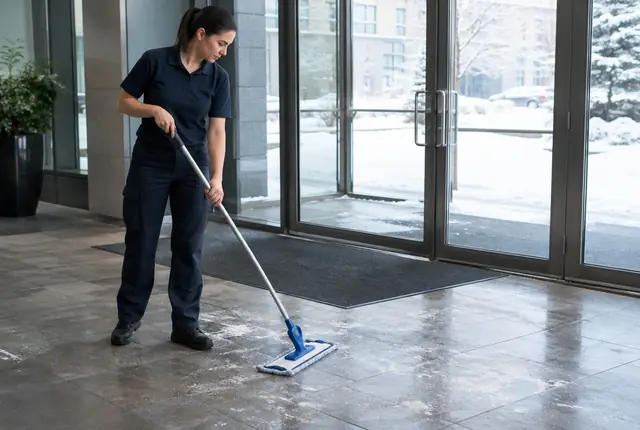
To remove salt from commercial floors, vacuum or dust mop the dry crystals first, then clean with a floor neutralizer instead of your regular cleaner, and rinse or extract. Regular alkaline cleaners smear the white film around. The bigger win is keeping salt out in the first place with 12 to 15 feet of matting at every door.
Northeast Ohio buildings fight salt for months. NOAA's 1991 to 2020 climate normals put average snowfall at Youngstown-Warren Regional Airport at 67.8 inches a year, and Spectrum News reported in October 2026 that ODOT crews drove 9.8 million miles and used nearly 813,000 tons of salt in the 2025 to 2026 winter. Every parking lot and sidewalk outside your doors gets salted too, and all of it wants to come inside on boots. This plan covers matting, the right cleaners, an entry schedule, what salt does to floor finish and carpet, and how to recover in spring. If you'd rather hand it off, our commercial floor care team runs this exact program on routes across the Valley.
Why Is Winter Salt So Hard on Commercial Floors?
Salt does damage two ways. The crystals are sharp and act like sandpaper under foot traffic, and the dissolved residue attacks the floor chemically. Betco warns that calcium chloride residue "can chemically damage the finish, causing hazing and premature degradation," and a 2016 Cleaning and Maintenance Management article says salt crystals etch hard floors and break down carpet fibers.
It also travels farther than most managers think. That same CMM article says snow and slush on shoes can be tracked more than 150 feet into a building. So the salt problem isn't only the lobby. It's the hallway, the elevator, the break room and the first few offices off the entry.
Different ice melts leave different messes. Rock salt (sodium chloride) dries to a white, powdery film. Calcium chloride pulls moisture from the air and leaves a sticky, oily film that stays damp and grabs dirt. Imperial Dade's guide on removing ice melt from carpet notes that ice melt is "very alkaline," which is exactly why a normal alkaline floor cleaner doesn't cut it.
| Floor type | What salt does | First sign to watch for |
|---|---|---|
| VCT with floor finish | Scratches and hazes the finish, then wears it through | Dull white haze in the first 10 to 20 feet past the door |
| Sealed concrete | Etches the sealer and leaves white mineral film | Chalky patches that come back after mopping |
| Commercial carpet and carpet tile | Cuts and dulls fibers, holds residue that attracts soil | White crust or dark, sticky traffic lanes |
| Ceramic tile and grout | Leaves film on tile and soaks into grout lines | Gray or white grout near entrances |
| Entry mats | Fill up with salt and stop working | Salt and wet prints past the end of the mat |
How Much Matting Does a Commercial Entrance Need?
Plan on 12 to 15 feet of matting per main entrance, split between outside and inside. A 2011 CleanLink article reported that ISSA, the worldwide cleaning industry association, estimates 80 percent of the soil, dust and contaminants in a facility come in through the door, and that it costs at least $500 to remove each pound once it's inside.
That same CleanLink piece quotes floor care distributor Jon Scoles recommending 12 to 15 feet of entrance matting outside and inside the door to capture 80 to 90 percent of the dirt on people's shoes. Mat maker NoTrax uses a 15 foot rule, so each foot hits the mat at least three times. Betco says an effective matting system can trap 90% of debris. AHF, the maker of Armstrong Flooring VCT, calls for mats inside and outside every entrance at about 8 to 12 feet long.
Most buildings use a three-zone setup:
- Zone 1, outside: a coarse scraper mat that knocks off snow, slush and salt pellets. NoTrax says this first zone removes up to 40% of dirt and moisture.
- Zone 2, vestibule: a scraper and wiper combination mat that starts drying shoes.
- Zone 3, inside: a wiper mat long enough that people take several steps on it before they hit the bare floor.
- Mats laid in the actual walking path, not just centered on the door
- A spare set of inside mats to swap in when the first set is saturated
- Rubber or vinyl backing that won't slide or curl on a wet floor
The mistake we see most is a single 3 by 5 mat inside the door and nothing outside. By mid-January that mat is a salt sponge. People step off it with wet, salty shoes, and the haze starts exactly where the mat ends. If you can only add one thing this winter, add length. A full mat run does more than any cleaner you can buy.
How Do You Remove Salt From Floors Without Spreading It?
Remove the dry salt first, then dissolve the film with a neutralizer and pick it up. Mopping straight over salt with a regular cleaner turns crystals into slurry and spreads the haze. Imperial Dade's ice melt guide warns not to use high pH cleaning chemicals, because they won't remove the residue and can do harm.
Here is the process for VCT, sealed concrete and tile:
- Dust mop or vacuum dry salt first. Betco recommends vacuuming abrasive salt particles with any rotating brush turned off or removed, so you don't grind crystals into the finish.
- Mix a neutralizer at the label dilution. These are mildly acidic cleaners made to dissolve ice melt residue. Mannington's 2025 commercial care guide lists slightly acidic mineral removers in the pH 4.5 to 5.5 range for mineral deposits.
- Apply and let it dwell. Imperial Dade says dwell time varies by product and is typically about 10 minutes. Don't let it dry on the floor.
- Agitate lightly. A soft pad on a floor machine or a scrub brush in corners loosens the film.
- Pick it up. Use an auto scrubber or a wet vac, or mop with a clean mop head and clean water. The goal is to remove the dissolved salt, not move it.
- Rinse once more in heavy areas and let the floor dry before people walk on it.
Check the label before you use an acidic product on stone. Betco notes its neutralizing cleaner is not for surfaces that acid can harm, like marble or polished stone, and points those surfaces to a different product. For salt stuck deep in grout lines, see our guide on how to clean grout.
A Daily and Weekly Entry Schedule for Salt Season
Salt control is a frequency game. The CMM salt article points out that rock salt and ice melt are part of the working environment for at least four to five months a year in the northern U.S. In the Valley, that usually means late November into March. This is the schedule we start from, then tighten after the first big storm.
| Task | Lobbies and main entries | Side and staff doors | Hallways past the entry |
|---|---|---|---|
| Vacuum or shake out mats | Daily, more after storms | Daily | Not needed |
| Dust mop dry salt | Daily, plus midday on storm days | Daily | Daily for first 50 feet |
| Neutralizer clean | Daily on storm days, 3 times a week otherwise | 2 to 3 times a week | Weekly |
| Swap or deep clean mats | Weekly | Every 2 weeks | Not needed |
| Spot extract carpet near doors | Weekly | Every 2 weeks | As needed |
| Buff or burnish VCT | Weekly | Every 2 weeks | Every 2 to 4 weeks |
Timing matters as much as frequency. The worst salt comes in during the morning arrival after an overnight storm. A quick dust mop and neutralizer pass at midmorning, before the haze dries and gets walked deeper into the building, saves hours of work later. That's one reason buildings with a daytime porter or a janitorial services crew on site hold up so much better through February.
How Do You Get Salt Stains Out of Commercial Carpet?
Vacuum the dry salt, spray a neutralizer, let it dwell, work it in, then extract with plain water. Imperial Dade's guide says salt pellets are hard and abrasive and cut and dull carpet fibers under foot traffic, and the residue leaves white crusty stains and attracts soil if it's left in place.
A few details make the difference:
- Vacuum thoroughly first, but don't run a standard upright over soaking wet areas
- Apply the neutralizer with a pump-up or trigger sprayer. Imperial Dade says not to add neutralizer to the carpet extractor tank
- Let it dwell about 10 minutes, then work it in with a brush or a floor machine with a carpet brush
- Extract and rinse with clean tap water, which the Restoration Industry Association says is needed so the residue doesn't reappear
- Repeat in the heaviest lanes and let the carpet dry fully before traffic
- Put a wiper mat over the first few feet of carpet inside the door for the rest of the season
Carpet tile at entrances gets hit hardest, and it's often cheaper to rotate a few tiles from under desks than to replace the whole lane. For full building carpet work, see our commercial carpet cleaning service, and for a sense of how often carpet needs a deep clean year round, read how often carpet should be cleaned.
What Does Salt Do to Floor Finish Over a Winter?
Salt wears floor finish from the top down. The crystals scratch the surface, the residue hazes and softens it, and by March the traffic lane past each door can be worn close to bare tile. Betco calls this premature degradation of the finish. The fix depends on how many layers are left.
Armstrong's VCT maintenance instructions call for 3 to 5 coats of commercial floor polish on the floor. If the haze is only in the top layers, regular buffing or burnishing brings back the shine. If salt has scratched and dirtied the top coats, a scrub-and-recoat removes them and lays down fresh ones. If the lane is worn through, the floor needs a full strip. Our post on strip and wax vs buff vs burnish walks through how to tell which one you need.
Burnishing through winter helps. A burnished finish is harder and tighter, so salt and water sit on top instead of soaking in. Our floor buffing and polishing visits are usually weekly at main entries during salt season for that reason.
Spring Recovery: Resetting Floors After Salt Season
Once the last salt is down, usually in March or early April here, it's time to reset. Doing the big floor work now means the new finish goes on after the damage season instead of into it.
- Pull, deep clean and store winter mats, or return rented ones
- Do a final neutralizer clean on every hard floor near an entrance
- Scrub-and-recoat VCT that still has a good base, or strip and refinish lanes that wore through
- Hot water extract all carpet near entries to pull out the salt left deep in the fibers
- Clean grout and tile at vestibules and restrooms near the doors
- Pressure wash the sidewalks and entry pads outside so leftover salt doesn't come back in on spring rain
- Note which doors did worst, and plan extra mat length there next fall
The fall side matters too. We add extra finish coats in October or November so the floor goes into December with a thick base. Stripping right before winter just means brand new finish takes the worst of the salt. For a full year schedule by building type, read how often VCT should be stripped and waxed.
How Phillips Care Handles Winter Floors
We start with a free walk-through before salt season. We look at every entrance, measure the mat runs, check how much finish is left in the traffic lanes, and note which floors are VCT, concrete, tile or carpet. Then you get a written winter plan with the entry schedule, the fall coats and the spring recovery work, plus a quote with flat monthly or per-visit pricing.
Phillips Care Cleaning has served Trumbull and Mahoning County since 2012, with commercial routes across Northeast Ohio. We're insured and bonded, we clean days, nights and weekends, and the same crew comes back each visit. The owner takes the call if anything is off. See our commercial floor care services or call (330) 219-7916 to book your walk-through before the first storm.
Sources
- CleanLink, Proper Matting Keeps Entryways Clean, Ronnie Garrett (Aug 8, 2011), retrieved 2026-10-16
- NoTrax, The 15 ft Rule for Entrance Matting, retrieved 2026-10-16
- Betco, 4 Major Winter Floor Mistakes for Facilities to Avoid (Nov 29, 2021), retrieved 2026-10-16
- Cleaning and Maintenance Management, Dealing With Salt During Harsh Winters, Joel Craddock (Dec 10, 2016), retrieved 2026-10-16
- Imperial Dade, Steps to Remove Ice Melt From Carpet (updated Apr 3, 2026), retrieved 2026-10-16
- Restoration Industry Association, Removing Tricky Ice Melt From Carpets (Apr 13, 2018), retrieved 2026-10-16
- Mannington Commercial, Flooring Product Care (links the Commercial Product Care Guidelines, Dec 2025), retrieved 2026-10-16
- AHF (Floor Expert), Maintenance Recommendations for Vinyl Composition Tile (VCT) with Diamond 10 Technology Coating (updated Apr 16, 2026), retrieved 2026-10-16
- Armstrong Flooring, Vinyl Composition Tile Maintenance Instructions (2025), retrieved 2026-10-16
- NOAA National Centers for Environmental Information, U.S. Climate Normals 1991-2020, Youngstown-Warren Regional Airport (USW00014852), annual snowfall normal 67.8 inches, retrieved 2026-10-16
- Spectrum News 1, ODOT prepares for Ohio's winter weather (Oct 12, 2026), retrieved 2026-10-16
Frequently asked questions
Winter Salt Plan questions, answered.
A free walk-through is the best way to plan your cleaning. These are the questions we hear most from Valley facility managers and owners.
What is the white film on my floor in winter?
It's dried ice melt residue. Rock salt leaves a white, powdery film, while calcium chloride leaves a sticky, damp film that grabs dirt. Imperial Dade notes that ice melt is very alkaline, so a regular alkaline floor cleaner usually just spreads it around. A neutralizer cleaner dissolves the residue so it can be picked up with an auto scrubber, wet vac or clean mop.
Can you use vinegar to remove salt from floors?
Vinegar is a mild acid, and neutralizer cleaners work the same basic way, which is why people use it at home. In a commercial building, a labeled neutralizer is the safer choice because it's made for floor finish and comes with a set dilution. Mannington's care guide lists slightly acidic mineral removers at pH 4.5 to 5.5. Never use acid on marble or polished stone.
How do you get salt stains out of commercial carpet?
Vacuum the dry salt, then spray a neutralizer with a pump-up or trigger sprayer and let it dwell about 10 minutes, as Imperial Dade suggests. Work it in with a brush, then extract with clean water. The Restoration Industry Association says a thorough rinse is needed or the residue reappears. Heavy lanes near doors may need a second pass.
How long should entrance mats be in winter?
Most guidance lands between 8 and 15 feet, depending on the source. A 2011 CleanLink article quotes a floor care distributor recommending 12 to 15 feet inside and outside the entrance to catch 80 to 90 percent of shoe dirt. NoTrax uses a 15 foot rule, and AHF calls for 8 to 12 feet at each entrance. Longer runs matter most at the main doors.
Should we strip and wax before winter?
Usually no. Fresh finish laid in November takes the worst of the salt and wears out by spring. A better plan is to add extra finish coats in the fall to build a thick base, keep up daily entry cleaning and weekly burnishing through winter, then scrub-and-recoat or strip in March or April after salt season ends.
Does salt damage concrete floors inside a building?
Yes. The 2016 CMM article on salt says the crystalline structure of salt products is damaging to all types of flooring and will etch hard floors under foot traffic. On sealed concrete, salt eats at the sealer and leaves white mineral film. Regular dust mopping, a neutralizer clean and resealing worn areas in spring keep it in check.
Related services
More from the same crew
Commercial Floor Care
Scrubbing, stripping, waxing and burnishing on a schedule that keeps VCT, vinyl and tile floors shining.
Explore serviceCommercial Carpet Cleaning
Hot water extraction for offices, churches, daycares and carpet tile, done overnight so it is dry by morning.
Explore serviceJanitorial Services
Recurring janitorial contracts: restrooms, trash, dusting and floors on a written checklist, nights or weekends.
Explore serviceRequest a free quote
One walk-through, one written price, one number to call: (330) 219-7916.
Start the conversation